Round Details
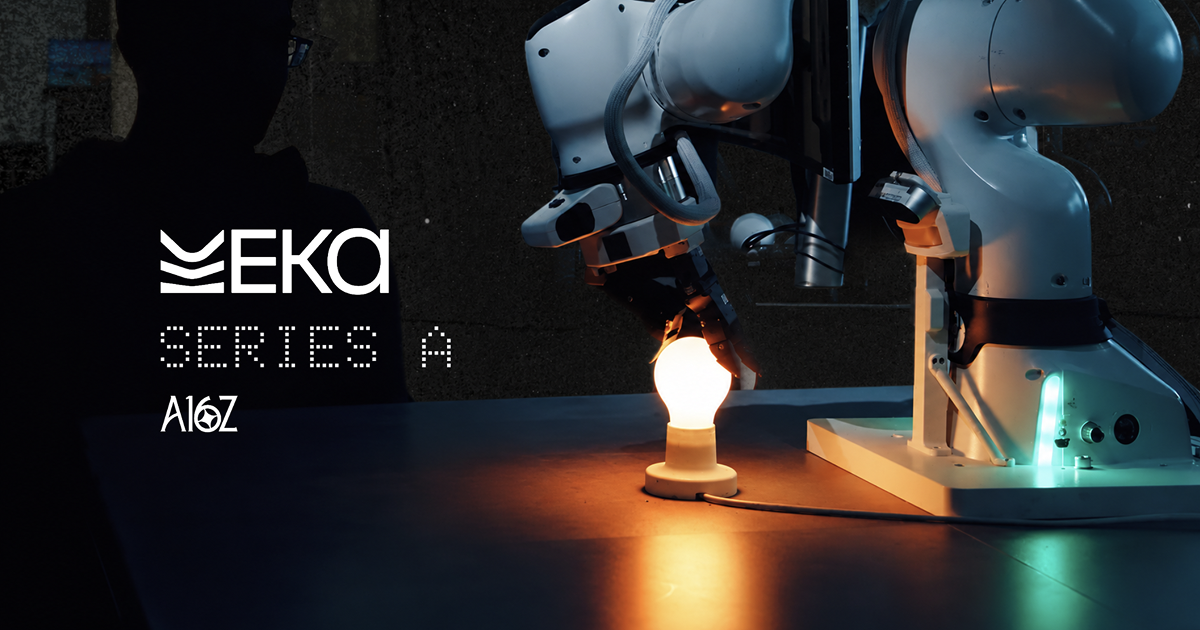
Robotics startup Eka Robotics announced on October 20, 2026 that it had closed a $150M Series A funding round. According to TechCrunch, the round was co-led by venture firms Andreessen Horowitz (a16z) and F-Prime, with a post-money valuation of $1.45 billion. F-Prime also participated as a co-lead of the round.
The company was founded by MIT professor Pulkit Agrawal and former Google DeepMind researcher Tuomas Haarnoja. Agrawal teaches at MIT, while Haarnoja previously worked as a researcher at Google DeepMind — both specialize in robotics and machine learning.
In its official announcement of October 20, a16z confirmed that it had led the Series A round and announced its partnership with Pulkit Agrawal and Tuomas Haarnoja. The news appeared the same day in both TechCrunch and on a16z's official site — meaning the details were confirmed in a single day by an independent publication and the lead investor itself. The involvement of a major fund like a16z as lead was noted as a signal of confidence in Eka's technical approach.
The Vision-Force-Action Model
Eka's technical approach differs from the vision-language-action (VLA) models widely used across the industry. The company has built a vision-force-action (VFA) model that combines visual perception with force feedback from the robot's grippers. The robot accounts not only for what it sees, but also for what is happening in physical contact with the object it holds — for example, if the object begins to slip, the gripping motion is corrected immediately. Where VLA models act by linking what the robot sees to an instruction, Eka adds a third link to that chain — force sensing: force signals from the grippers continuously report on the object's state, and the model adapts its motion in real time based on that information. Force feedback helps the robot find the pressure needed to avoid crushing or dropping the object — which matters most when handling fragile or slippery items.
The training method also departs from the norm. Instead of learning from human demonstrations, Eka applies reinforcement learning inside physical simulation: virtual robots practice repeatedly across diverse situations and learn from failure states as well. This approach yields broader experience than the limited set of demonstrations a human could provide, since thousands of scenarios can be tested risk-free in simulation. In simulation, the robot can safely try out many scenarios, while human demonstrations take time and cannot cover every failure case — which is why Eka chose a scalable training path that does not depend on the human factor.
According to the company, the system has reached up to 1,500 picks per hour in laboratory induction and tote-sorting tasks — nearly 2.5 times faster than human performance, with reliability above 95%. The economics are also notable: Eka's gripper hardware costs under $1,000 and is rated for 5 million work cycles. The combination of cheap hardware and high speed is a key factor for industrial-scale deployment of the technology.
Expert Reactions
The company's demonstrations have won recognition from experienced roboticists. UIUC professor Kris Hauser singled out the robot's ability to adapt to many objects without retraining:
"There's a wow factor in how the robot adapts to many objects without retraining," said UIUC professor Kris Hauser.
An unnamed roboticist from a leading lab compared this moment to the period five to ten years ago when robots achieved reliable legged locomotion. The name of the specialist who made the comparison was not disclosed — TechCrunch describes him as a roboticist at one of the leading laboratories. Both opinions were given in connection with Eka's public demonstrations and show that the VFA approach has sparked serious interest among industry specialists.
Pilots and Next Steps
Eka is currently running confidential pilot projects with industrial customers. The tests cover practical tasks such as pick-and-place and wire manipulation. The closed nature of the pilots reflects the company's decision not to disclose its customer list for now. Within the tests, pick-and-place and wire manipulation tasks are being carried out — both are practical processes that demand delicate physical movement from the robot.
According to TechCrunch, the company faces two main tasks: sustainably maintaining the high laboratory performance across full production shifts, and proving the model's generalization ability beyond pick-and-sort tasks. Generalization ability means the robot can transfer skills learned in one task to new objects and conditions — and it was precisely the demonstration of this property without retraining that drew specialists' attention.