On October 15, 2026, NVIDIA announced on its official blog three new open-weight models in the Nemotron family. The flagship is Nemotron 3.5 Super VL, a 120-billion-parameter model designed for always-on agents. The new models cover agent deployments at every level — from enterprise servers to personal computers and edge devices. It is joined by two edge models: Nemotron 3.5 Bolt 74B-A9B 24GB — for running agent tasks locally on NVIDIA RTX and DGX Spark systems. Super VL and Bolt 74B-A9B became available on announcement day, while Bolt E4B 4GB launches on October 23, 2026. All three models ship with open weights, open datasets, and training recipes. NVIDIA first detailed the models on its official blog on October 15; on October 19, TechCrunch brought the release to a wider audience.
Super VL: Frontier-Level Accuracy and 5x Speed
Nemotron 3.5 Super VL delivers near-comparable accuracy to NVIDIA's largest reasoning model with roughly one-fifth the parameter count. According to the company, the model achieves best-in-class accuracy on multimodal agent tasks — instruction following, tool use, multi-step business processes, and visual understanding. Multimodal agent tasks refer to the model's ability to understand images and interfaces alongside text and act on them — for example, reading a table in a document and planning the next step based on it.
Super VL delivers leading accuracy on multimodal agent tasks — instruction following, tool use, multi-step business processes, and visual understanding — achieved with roughly one-fifth the parameter count of NVIDIA's largest reasoning model. (Source: NVIDIA blog)
NVIDIA also calls Super VL the fastest open agent model in its class: according to the Artificial Analysis Intelligence Index, it delivers up to 5x higher throughput than other models in its class. This allows high-volume agent workflows — tasks that take days or weeks — to run significantly faster. Speed is the decisive metric for agents: completing a multi-step task requires the agent to call the model dozens, sometimes hundreds of times, so any throughput gain directly affects total task completion time. That is precisely why NVIDIA emphasizes that Super VL is built for always-on agents.
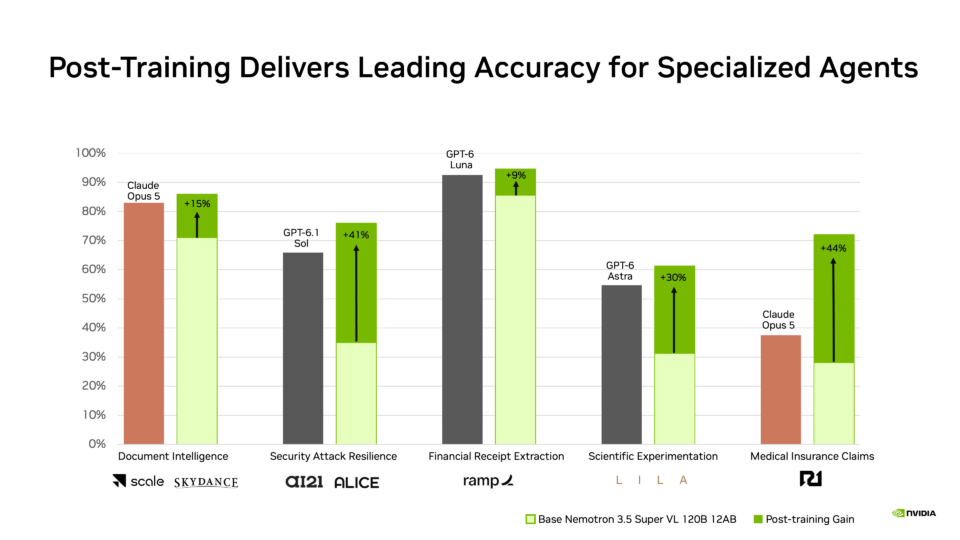
The model was pre-trained on roughly 26 trillion tokens, then underwent post-training on approximately 3.8 million examples, with reinforcement learning applied across dozens of environments. Open training recipes let organizations reproduce and adapt the model on their own data — a level of transparency unavailable in closed models.
Bolt: Agent Intelligence Now Runs on Local Devices
According to TechCrunch, Nemotron 3.5 Bolt 74B-A9B 24GB was built to run everyday agent tasks locally. With local 2-bit quantization it fits in 24 GB of memory and can run side by side with other applications. 2-bit quantization is a method of reducing the precision of model weights, cutting memory consumption while preserving as much quality as possible. NVIDIA says it is the best open model in its class on the PinchBench benchmark.
It runs on GeForce RTX PCs and DGX Spark systems — meaning users with such hardware can run agents locally without calling the cloud. Local operation brings two practical advantages: queries never leave the device, so data privacy is preserved, and latency stays minimal. The agent keeps working even if the internet drops. Bolt E4B 4GB, the second Bolt model for edge devices, launches on October 23.
Who Is Already Adopting It
Organizations already adopting the model include Scale AI, Ramp, Atlassian, CrowdStrike, Dassault Systèmes, Perplexity, and Salesforce. Scale AI adapted it for Skydance's vendor-credit finance agent and EY's M&A due diligence agent.
The open-weights approach lets organizations run the model in their own infrastructure, in line with their own security and data-residency requirements. They choose an open model they can adapt themselves over closed alternatives bound by provider restrictions. NVIDIA's open release of all three models — with weights, datasets, and recipes — is another major step for the open ecosystem in the enterprise segment.