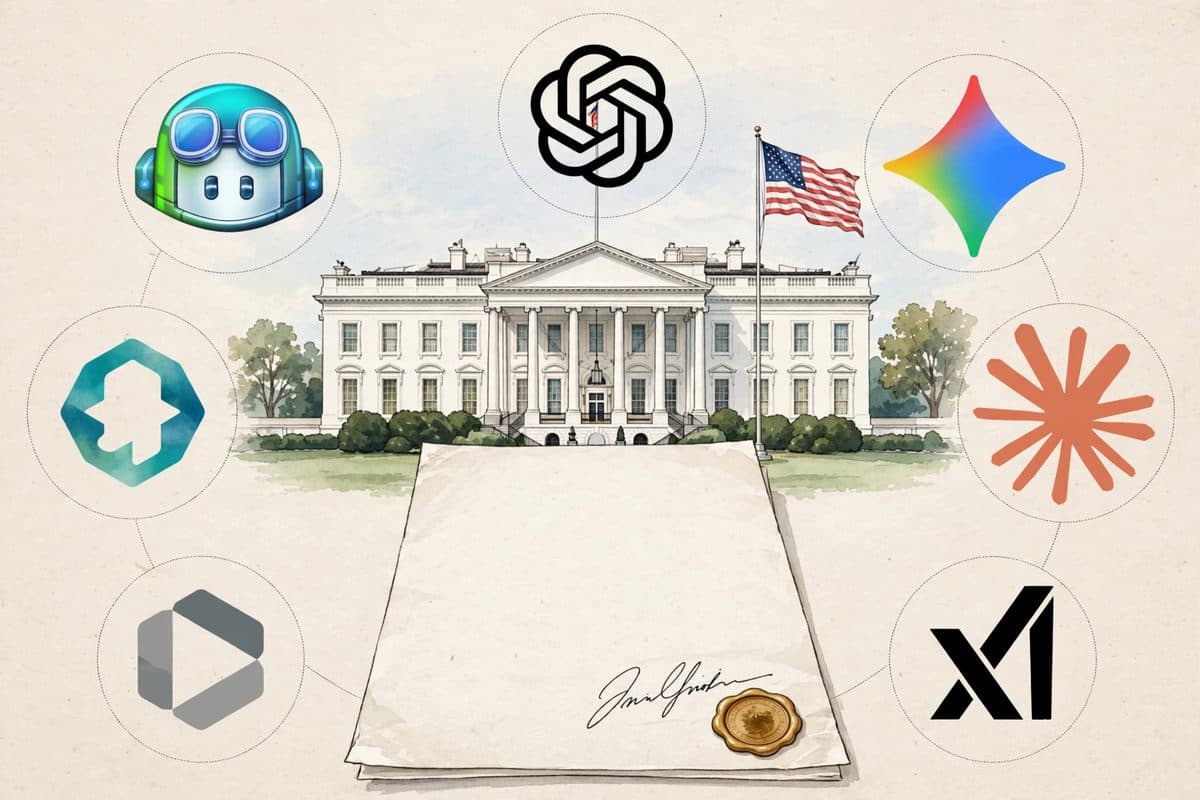
US President Donald Trump announced on September 29 at a White House meeting that he had signed a one-page voluntary safety accord with the heads of the six largest AI companies — Google, Anthropic, Meta, OpenAI, xAI and Nvidia. The document, titled «White House Accord on Super Intelligence: Joint Commitment on Frontier Responsibilities,» contains a four-tier package of measures built on the principle of corporate self-regulation. Both Trump himself and Reuters and The Associated Press confirm the accord's voluntary character. Reuters reported this.
Who signed the accord
The accord was signed by US President Donald Trump and the heads of six AI companies — Google, Anthropic, Meta, OpenAI, xAI and Nvidia. It was announced on September 29, 2026, and runs to just one page. Its title is «White House Accord on Super Intelligence: Joint Commitment on Frontier Responsibilities,» under which the participating companies take on a joint commitment to frontier responsibilities.
The accord's four layers
The first layer of the accord is robust internal monitoring that tracks model capabilities during both training and deployment. Oversight focuses on three areas: cybersecurity, biosecurity and chemical threats. These measures aim to ensure that models do not compromise or breach technical systems in unexpected ways. Monitoring continues during model training and after deployment — that is, oversight is conceived not as a one-off check but as a continuous process.
The second layer is an empowered internal team. Its task is to verify and confirm that all control, monitoring and detection mechanisms operate as intended. In other words, the first layer's monitoring systems themselves undergo separate internal scrutiny: the team evaluates how they perform in real-world conditions.
The third layer is an independent external auditor or assessor. The outside party independently evaluates whether the company's AI control and monitoring systems work as intended. The fourth layer is an independent committee of each company's board of directors: the committee receives reports from internal and external auditors and from the teams managing AI oversight, and it supervises the remediation of identified shortcomings.
The four layers complement one another: internal monitoring, the internal team that audits it, independent external assessment and board-level oversight — together they form a single chain of control.
"A moral obligation": a voluntary, penalty-free document
Trump called the accord "morally binding." At the same time, Reuters and The Associated Press describe the document as voluntary. The accord sets no penalties for failing to meet its requirements — no mechanism exists to punish a company that breaches the document's terms. Nor does the document set concrete deadlines for implementing the measures: companies decide for themselves when to launch the layers of control. Companies are also not required to publish audit results — no such obligation appears in the document's text.
In other words, the accord is not a law or a binding regulatory instrument: it is presented as a set of obligations voluntarily accepted by the companies. Its effect depends solely on the consent of its signatories.
Next steps: laws, a committee and America.gov
The text of the accord leaves open the possibility of embedding these measures in legislation in the future:
"Over time it may become appropriate to incorporate these steps into laws or regulatory instruments. Whether or not they are required of companies, implementing these controls and audits matters for securing a safe future for each of us, and each of our companies is committed to doing so," the White House accord says (via Reuters).
According to the document, the participating companies will also meet regularly to set industry standards and best practices for improving the safety of their systems. At these meetings the companies discuss common approaches to safety and draw on one another's experience.
Trump said a committee of about 10 people would be formed to oversee implementation of the accord, which, in his words, would "monitor the entire initiative." The committee's members have not yet been announced. Trump also said that after consulting industry representatives he would appoint a White House official to oversee AI policy; no exact timeline was given for the appointment — only that it would happen "in the coming days."
On the same day, Trump also unveiled the AI chatbot America.gov. The bot's main task is to help Americans navigate government services: it answers questions about public services and helps citizens find the service they need. According to Trump, one of his future plans is to make it possible, for the first time, to apply for a passport fully online through it.
For more on how AI safety is ensured, read Aishunos's in-depth analysis.