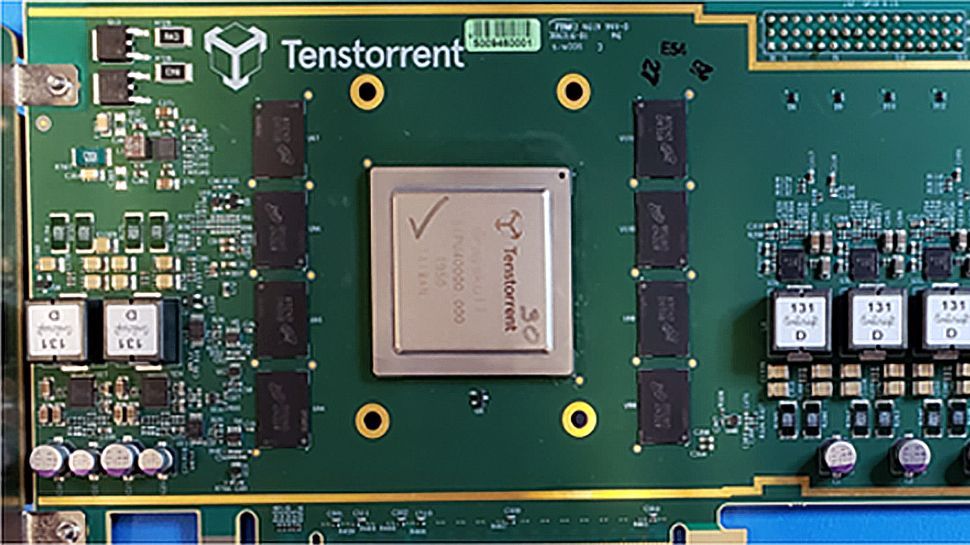
AI chip startup Tenstorrent announced on October 19, 2026 that it raised $1.5B in a late-stage Series E round. The deal brought the company's post-money valuation — its total estimated value including the new investment — to $6.2B, more than double its late-2024 level of $2.6B. The 10-year-old Santa Clara company is considered one of Nvidia's main rivals in the AI chip market and specializes in inference — the stage of deploying trained AI models in real-world use. Reuters and TechCrunch reported the deal on the same day; the company also issued an official statement about the round.
Funding Round Details
The round was led by Trace Capital and Innovation X. Trace Capital is a new investment fund formed ahead of the deal, led by Ben Mahdavi, a co-founder of Quiet Capital. According to Reuters, ARK Invest, SanDisk, Morgan Stanley, T. Rowe Price, and Tether Investments also participated. TechCrunch additionally listed Cadence Ventures, Eclipse, and Fidelity among the investors; SanDisk and T. Rowe Price appeared in both sources. Reuters described the round as late-stage financing — Series E rounds typically happen when a company already has a product and customers and is entering an expansion phase. TechCrunch confirmed the round size and valuation figures. Both outlets noted the sharp rise from the $2.6B valuation at the end of 2024 — the company's value more than doubled in under a year. Reuters made that growth — the more-than-doubling of its value — the focus of its headline.
Galaxy Servers and Open Architecture
The funding will go toward expanding production of Galaxy servers. Galaxy servers combine dozens of Tenstorrent chips into a single computing system and power applications such as chatbots, coding assistants, and video generators. Such systems run in data centers requiring large amounts of computing power — so the money will increase Tenstorrent's ability to deliver products at real infrastructure scale. In other words, the investment will go toward manufacturing Galaxy servers in greater numbers. Tenstorrent develops software for its AI chips as well: having chips and software under one roof makes it easier to optimize the chips for working with AI models. The company's key technological distinction is that its chips are designed on the RISC-V architecture. RISC-V is an open-source chip architecture: its technical documentation is publicly available and allows processor design without licensing fees. This reduces dependence on proprietary ecosystems like Arm.
Independence Preserved
The round was announced against the backdrop of the company's decision to stay independent. Five months ago — around May 2026 — Intel and Qualcomm had expressed interest in acquiring the 10-year-old startup at a valuation of up to $5B, Bloomberg reported. But Tenstorrent chose independent growth over a sale. CEO Jim Keller — whom TechCrunch calls a famous microprocessor engineer — told Bloomberg that after demonstrating that Galaxy servers could run DeepSeek models, the company decided to remain independent and raise additional funding. In his words, it was the DeepSeek demo that proved the company could grow on its own and underpinned the decision to raise.
"After demonstrating that our Galaxy servers could run DeepSeek models, we decided to remain independent and raise additional funding," said Tenstorrent CEO Jim Keller (via Bloomberg).
New funds will go toward scaling chips optimized for serving open-weight AI models and for video generation — open-weight models are those whose weights are published openly and can run on any compatible infrastructure. TechCrunch cited this direction as the round's main goal.
The Hardware Wave
TechCrunch framed Tenstorrent as part of a wave of AI hardware startups challenging Nvidia's dominance. The outlet reported that this week, another AI chipmaker — Etched — was also receiving funding offers at a $40B valuation and above: that news broke earlier this month. TechCrunch presented Etched as part of the same wave challenging Nvidia's dominance.