The announcement: what was said at PyTorch Conference 2026
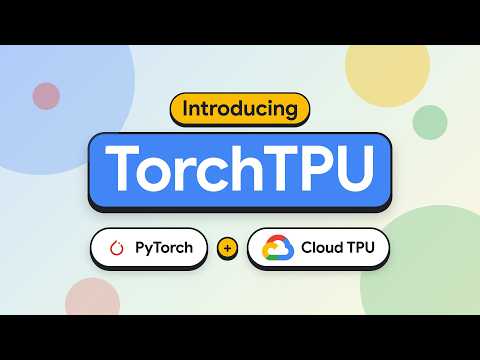
On October 20, 2026, Google made a major announcement at PyTorch Conference 2026: TorchTPU, its native PyTorch stack for TPU chips, is now available on GitHub as an open-source project. TPUs have thus become a native option for PyTorch developers — alongside GPUs and CPUs.
The essence of the announcement: TPU is no longer a separate software world for PyTorch but a hardware option natively supported inside PyTorch itself. Developers keep working with familiar PyTorch interfaces — hardware differences are hidden by the software layer.
TorchTPU makes it possible to run AI applications on Google's Tensor Processing Unit chips. Migrating an existing PyTorch application to TPUs and Google Cloud takes a simple configuration change — no code rewrite is required. Details: Google Cloud Blog.
In practical terms, this means TPU is now a native hardware option for PyTorch projects next to GPUs and CPUs. When choosing hardware, developers don't need to switch software stacks — they stay within PyTorch itself.
How it works: from eager mode to torch.compile
TorchTPU was developed jointly with the PyTorch team at Meta. The project's core promise is simple: run existing PyTorch workloads on TPUs with almost no changes.
The workflow has two stages. First, the developer runs the model in eager mode — at this stage the model can be inspected and debugged. Once the model is ready, torch.compile kicks in and the project moves to production-grade performance.
Crucially, developers don't have to abandon PyTorch itself to move to TPU. Standard PyTorch APIs are preserved, so teams keep working with the tools they've already mastered.
In other words, teams don't throw away existing knowledge and codebases when moving to TPU. Both eager-mode inspection and the performance transition via torch.compile are PyTorch's own mechanisms — they need no learning; they're already familiar.
Ecosystem: familiar tools work on TPUs
With TorchTPU, developers can train models on TPUs, run them as services, and deploy them — using open tools they already rely on daily: vLLM, SGLang, llm-d, TorchTitan, Ray, TorchRec, Hugging Face, and LiteRT.
Google partnered with Hugging Face — as a result, popular open-weight models on the Hub run natively on TorchTPU. In Transformers v5, moving a model to TPUs takes just the device_map="tpu" parameter.
These integrations show TorchTPU not as a standalone project but as a broad part of the PyTorch ecosystem: at every stage of the pipeline — from training to serving — the familiar tool works on TPUs.
All three stages are covered: at the training stage models are trained on TPUs, at the serving stage finished models are run, at the deployment stage they go into production environments. At each stage the developer uses a tool they know — no new tool to learn.
Meta is using it in core production workloads
Meta confirmed it uses TorchTPU in its core production workloads. Meta's director of PyTorch engineering, Jana van Greunen, said:
"We can't stay limited to a single hardware architecture. TorchTPU supports core workloads of large language models (LLMs), ads, and recommendation systems."
— Jana van Greunen, Director of PyTorch Engineering at Meta.
The announcement specifically highlighted Meta's use of TorchTPU in core production tasks. This means the project isn't at the experimental stage — it's been tested on a large company's real workloads.
According to Jana van Greunen, being limited to a single hardware architecture is unacceptable for the company. TorchTPU solves exactly this problem: it enables core workloads — large language models, ads, and recommendation systems — to run on TPUs.
Two fronts against Nvidia's dominance
According to TechCrunch, Google joined Amazon with this announcement. A day earlier, Amazon had also released its own PyTorch variant for its Trainium chips — TorchNeuron.
Both companies share one goal: shaking Nvidia's stronghold in the AI industry. Today most AI applications are written by default to run on Nvidia GPUs, and for developers the GPU has effectively become the only standard.
Google and Amazon now offer developers an alternative: a PyTorch application can be moved to other chips with a small configuration change, without rewriting code.
The timeline is also noteworthy: Amazon's TorchNeuron announcement came out on Monday, Google's TorchTPU announcement on Tuesday — only one day apart.
Both projects are built on PyTorch, so developers stay in a familiar framework. The only difference is hardware: instead of Nvidia GPUs, they can choose Google TPUs or Amazon Trainium chips.