
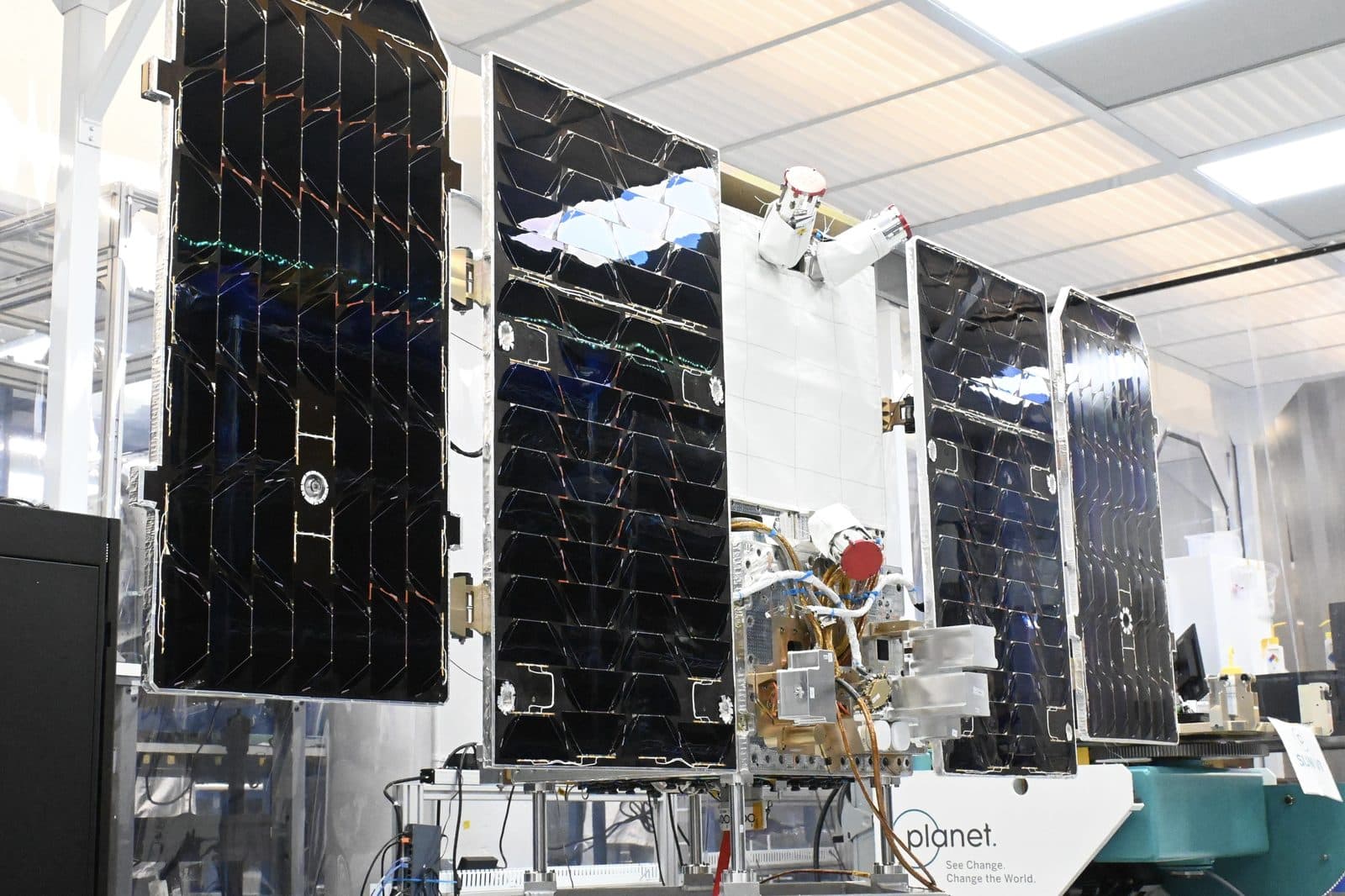
On October 1, 2026, Google launched its first orbital compute prototype satellite. It flew from California aboard SpaceX's Transporter-18 rideshare mission (multiple payloads on a single rocket), carrying Google's Tensor Processing Unit (TPU) chip — the first such chip the company has ever sent into space. TechCrunch reported the news.
First Flight
The satellite was built in partnership with Planet Labs. It is the size of a refrigerator and carries four TPUs. The mission will last a year and is designed to test whether the chips can withstand the intense vibrations of launch, radiation, and extreme temperature swings. According to The Wall Street Journal, this is the first real-world experiment testing whether the chips can operate in orbit.
The TPU is Google's specialized chip for artificial intelligence (AI) computing, developed as a competitor to Nvidia's graphics processors. The project is called Project Suncatcher, and its goal is to build large-scale compute clusters in Earth orbit. Today Google builds enormous data centers on Earth to train and run AI models; the project explores whether some of that load could be moved to orbit in the future.
Three Key Tests: Vibration, Radiation, Temperature
Over the year-long experiment, engineers will evaluate three main risks. The first is launch stress: the violent shaking and acceleration of the rocket engines could affect the mechanical integrity of the chips. The second is cosmic radiation: outside the atmosphere, particles striking the chip's logic circuits could cause errors. The third is extreme temperature swings: in orbit, the difference between the sunlit and shadowed sides is enormous.
These three factors cannot be fully replicated in ground-based laboratory tests — which is why Google decided to test the chips in a real space environment.
The Chip Runs in 15-Minute Bursts
After the commissioning phase, the satellite's TPU will be switched on in short 15-minute cycles. This regime was chosen to avoid overloading the satellite's power and thermal management systems: in the vacuum of space, heat does not dissipate through convection, so a chip operating inside a refrigerator-sized body could strain the cooling system. While running, the chip draws about a kilowatt of continuous power and runs AI models — engineers will watch for any malfunctions during the process.
The 15-minute cycles are a cautious start: if the chips run stably under such short loads, heavier loads could be tested in later phases.
The 81-Satellite Orbital Data Center Plan
Project Suncatcher's long-term vision is an orbital data center. Under the plan, 81 satellites will fly in close formation, processing workloads in parallel. "Close formation" means the satellites travel small distances apart, in coordinated motion; parallel processing makes it possible to distribute a task across multiple chips.
They will travel in sun-synchronous orbit — an orbit where sunlight falls almost constantly, so the satellites will be powered mainly by solar energy. On Earth, data centers draw large amounts of electricity from the grid; in orbit, the energy source will be the sun itself.
Google estimates that bandwidth and latency between TPUs will be critical for running multi-rack workloads. The company is focused on building infrastructure designed not for today's AI workloads, but for future ones.
The Joule Paper and the 1,800-Launches Calculation
Alongside the project, Google published a peer-reviewed version of its scientific paper on orbital data centers. The paper will be published in the journal Joule. It presents one of the most detailed analyses of ways to move computing power into orbit.
The study says that reaching a launch cost of about $200 per kilogram by 2035 would require the Starship rocket to deliver 370,000 tons of cargo to orbit. That is roughly 1,800 launches over ten years — 180 flights per year (assuming 200 metric tons of cargo per flight).
The calculation is based on SpaceX's "learning curve," which has reduced annual costs by about 20% since the Falcon 1 rocket: the assumption is that growing experience makes production cheaper. For comparison: Starship has never flown more than five times in a year — meaning the launch rate would have to grow dozens of times over the current one to reach 180 flights a year.
"We've done testing on the ground, but there's no test completely as good as the real thing," Travis Beals, the Google senior director managing Project Suncatcher, told The Wall Street Journal.
According to Beals, the ground tests were useful; the year-long orbital experiment will show directly how the chips perform in real space conditions.