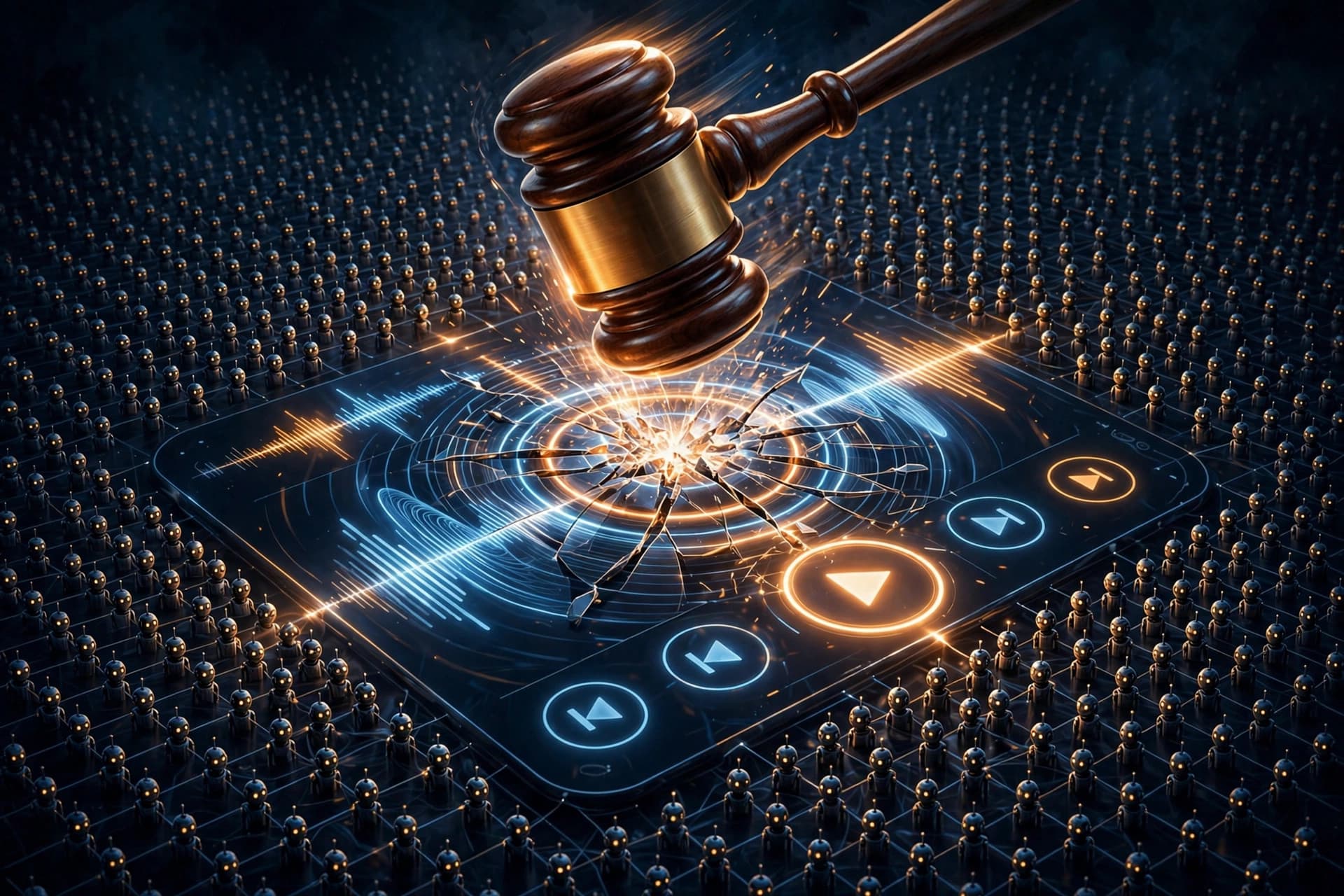
Michael Smith, 54, of Cornelius, North Carolina, pleaded guilty to stealing royalties from streaming platforms and musicians using AI-generated songs and thousands of fake bot accounts, and was sentenced on October 7, 2026 to 18 months in prison. According to the U.S. Department of Justice, he is the first American to be criminally charged for AI-assisted streaming fraud.
The fraud scheme ran from 2017 to 2024 — seven years. During that time, Smith artificially inflated plays of his own AI-generated songs on streaming services and pocketed the royalties paid per stream. At times the scheme ran 10,000 bot accounts simultaneously, and the estimated damage was about $8 million.
The Fraud Scheme Worked in Three Stages
According to prosecution materials, the scheme consisted of three consecutive stages. First, Smith created thousands of fake user accounts on streaming platforms. Then, through special software, he directed those accounts to play his own AI-generated songs nonstop. Finally, he collected the royalties credited for those artificial plays in his own name. Creating thousands of fake accounts and keeping them streaming the songs around the clock was automated with special software.
Streaming platforms pay royalties to performers and rights holders every time a song is played. The more plays, the higher the payment — which is why generating artificial plays through bots diverts the royalty stream to the fraudster. Smith exploited exactly that mechanism: since the songs belonged to him, every play generated by the bots came back to him as payment.
The scale of the scheme is stark in a single month's example: in April 2023, Smith's bot accounts streamed his AI songs 80.9 million times on YouTube Music family plans. For comparison, Taylor Swift's entire music catalog received 9.3 million streams that month. Those figures are cited in the official statement of the U.S. Department of Justice.
The 80.9 million and 9.3 million figures were cited by prosecutors to illustrate the scale of the scheme. The first number is the count of artificial plays generated by Smith's bots in a single month; the second is the number of streams earned that same period by the real audience of one of the most popular artists.
Sentence: 18 Months in Prison and an $8 Million Forfeiture
Smith pleaded guilty before the case went to trial: on March 19, 2026, he admitted guilt on one count — conspiracy to commit wire fraud. Under the sentence handed down on October 7, he will serve 18 months in prison, followed by 2 years of supervised release after his release. The court also ordered the forfeiture of $8,091,843.64 to the state — a sum announced by the prosecution.
Smith used "super intelligence" technology to commit fraud, said U.S. Attorney Jaime McDonald.
From Guilty Plea to Sentencing
Smith pleaded guilty on March 19, 2026 — admitting guilt on a single count, conspiracy to commit wire fraud. Six and a half months later, on October 7, the court issued the final sentence: 18 months in prison, 2 years of supervised release, and a forfeiture of $8,091,843.64. The investigation and trial of the scheme that began in 2017 are thus concluded.
The First Criminal Case Over AI-Assisted Fraud
The Department of Justice recorded this case as the first in the United States in which someone was criminally charged for AI-assisted streaming fraud. According to prosecutor Jaime McDonald, Smith used "super intelligence" technology to commit fraud — a phrase cited in the department's statement. Ars Technica reported on the October 7 sentence, writing that the 54-year-old North Carolina man was sentenced to prison for stealing $8 million in royalties through 10,000 bots and AI-generated songs.
AI-assisted song creation has become widespread in recent years: such tools make it possible to produce large numbers of tracks in a short time. Smith exploited exactly that capability — his songs were created with the help of artificial intelligence, and he was their rights holder.
The Department of Justice's statement specifically emphasizes that Smith's case is the first in which someone was criminally charged for AI-assisted streaming fraud. That characterization defines the essence of the case: artificial intelligence technology was used in the fraud, and it was tried as a criminal case in federal court.