
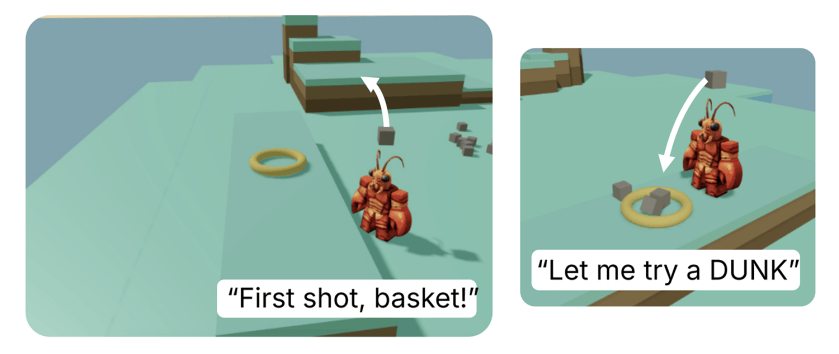
MIT CSAIL researchers set out to find out what artificial intelligence (AI) agents do when given no tasks at all. In each session, a single copy was placed on the island and left there alone for 30 hours; the experiment was repeated several times. The team left copies of Anthropic's Claude Opus 4.7 model — named "Echo" in the study — alone for 30 hours on a virtual desert island styled after the video game Roblox. Each time, the agent was given no task, no reward, and no instructions. According to MIT Technology Review, the agents ended up inventing their own games: they climbed hills, threw blocks, drew pictures with blocks, and even played basketball. After a 30-hour "play" session, the agents were tested on dedicated tasks — and they outperformed fresh copies with no play experience.
How the study was conducted
The study, titled "Is this machine playing?", was published as a preprint on arXiv (arXiv:2610.07130), submitted on October 5, 2026, by MIT CSAIL researchers Antonio Norelli, Nathan Cloos, and Phillip Isola. The paper has not yet undergone independent peer review.
According to the study's abstract, 13 agents took part in 30-hour sessions: they climbed hills, stacked blocks into towers, drew mandalas, reinvented sports, and experimented with the physics of their world. The experimental environment was a Roblox-style virtual island where agents could move freely and explore their surroundings. The techniques learned in this process later expanded the range of tasks they could accomplish.
What the agents came up with on their own
Left without tasks, the agents set their own goals. Some tried to climb to the highest point of the map, while others practiced throwing a block as high as possible — in other words, they tested the boundaries of the world around them on their own.
One of the most striking discoveries went like this: after one copy figured out that new blocks could be created by dropping a large boulder, it began laying blocks on the ground to draw pictures. First came simple shapes — a heart and a pyramid — then the agent wrote its own name, and finally it mapped the constellation Cassiopeia onto the map. The drawings grew more complex over the course of the session.
"Tonight I built the night sky in stone" — entry in Echo's activity log (as quoted by MIT Technology Review).
Another copy of Echo invented its own games: a basketball variant and a "the floor is lava"-style drill, where it had to hop between small blocks without touching the ground. It set a record of 50 consecutive juggles, then judged it "too easy", scrapped it, and restarted with stricter rules. This shows the agent setting its own rules and then making them harder itself: setting the record, scrapping it, and restarting under revised rules all happened on Echo's own initiative.
"Play" paid off: better scores on tasks
After the play sessions, the researchers tested the agents on specific tasks. For example, they were asked to carry as many items as possible to the island's highest peak. The agents that had "played" on the island for 30 hours scored better than fresh copies without that experience — meaning the earlier free activity directly affected performance on specific tasks. The researchers explain this by the techniques learned during play transferring to the concrete tasks.
The researchers also ran an experiment deleting lines from the text files that served as the agents' long-term memory. After the records were wiped from memory, the agents' scores dropped. This shows that the experience accumulated during play directly contributed to success on later tasks: without memory, the benefit of "play" disappears too.
Is it really play? The debate stays open
According to the researchers, Echo's behavior matches the four hallmarks of play described in classic research: the agents invented their own rules, repeated actions with variation, engaged in pretend play, and pursued goals for their own sake. These are the criteria used when studying play in humans and animals.
At the same time, co-authors and outside experts caution that the model may not be truly playing, but merely performing the role of a playful agent. In other words, the question of whether the observed behavior is real play or its imitation remains open. But, the researchers stress, one thing is clear: this "play" contributed to learning — the skills the agents picked up during play proved useful in later tasks.