
The gist
On October 1, 2026, Shopify introduced a new way to build online stores. A tool called Canvas lets merchants set up and modify a store through an ordinary conversation with Shopify's AI agent Sidekick. According to the company's official announcement, Canvas is a new design space that merchants build together with Sidekick; it will begin rolling out to merchants gradually in the coming days. The company plans to deliver the tool in stages rather than to everyone at once.
The new tool combines two jobs: a merchant can create a store from scratch or modify an existing one — in both cases communicating with Sidekick in chat. Shopify's official announcement is titled "Introducing Canvas" and says Canvas opens new possibilities in online store design.
How Canvas works
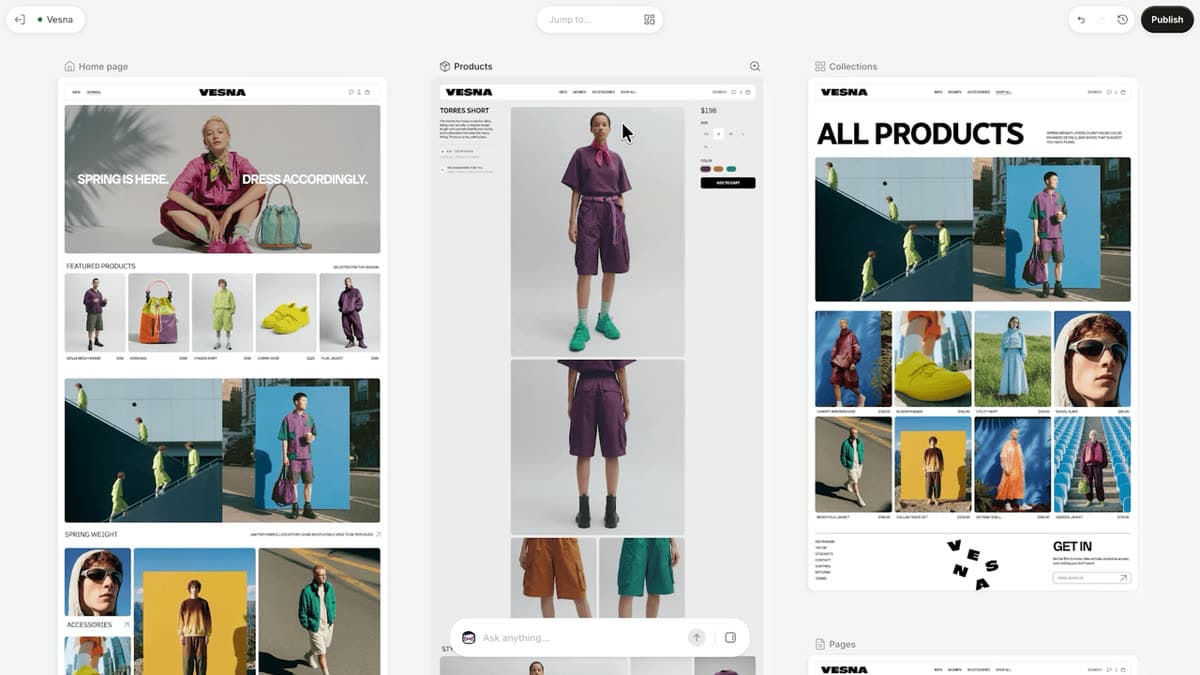
Canvas works like this: the merchant tells Sidekick in chat what needs to be done, and as the agent makes the changes, Canvas shows the result in real time. Importantly, the image on screen is not a static preview — it's a rendered view of the actual code behind the store.
So merchants can test the page's full interactivity: elements behave as in a live store, and animations can be checked right there. There's also a way to see how pages look on different screen sizes. As soon as changes are made, the result appears on screen — the merchant immediately sees the effect of each step and can ask Sidekick for fixes if needed. That means what the merchant sees is the future store itself, not a separately prepared mockup.
Sidekick sees what the merchant sees
One important Canvas detail: Sidekick takes screenshots of its own work. So as the site updates, the agent sees exactly what the merchant sees: the changes render identically for both sides. The agent observes the changes from the same vantage point as the merchant, and both sides work on the same result.
On the other hand, merchants don't rely on chat alone: if they want, they can click individual elements and edit them directly. In other words, Canvas offers two working modes side by side — making changes through conversation with Sidekick and manually tweaking a selected element. This approach preserves both the convenience of conversation and precise control.
The preparation behind 25 million edits
According to Shopify, Sidekick made more than 25 million edits to merchants' themes in the first half of 2026. Canvas is built on that practical experience: Shopify gave the agent the ability to work directly with theme files and simplified the theme architecture. More than 25 million edits show that Sidekick is widely used in merchants' real stores.
The goal of the simplification is clearly defined: the agent can now move freely among the templates and files that make up a theme and make coordinated changes across them. That is, Sidekick no longer works with individual theme parts in isolation but accounts for the entire structure.
"A fully customized store in twenty minutes"
According to Shopify product director Ben Sehl, an entrepreneur on Shopify can now build a fully customized store in about twenty minutes — previously even a founder who could code needed two weeks for that.
The quote comes from the company's official announcement. Ben Sehl serves as product director at Shopify. In his words, where even a founder who knew how to write code once needed two weeks to launch a working store, today an entrepreneur on Shopify can build a fully customized store in twenty minutes. With this comparison, the company wants to show Canvas's main advantage — a dramatic reduction in store-building time.
Initial limitations
Canvas is still an early-stage product, so a number of capabilities are missing from the initial release. Third-party theme support, app blocks and extensions, markets, translations, staged rollout, and theme updates — all of these remain outside Canvas for now. In other words, in the first phase Canvas doesn't work with third-party themes.
Also, Canvas is currently designed for desktop computers only. Another important limitation: themes edited with Canvas will no longer receive automatic theme updates. TechCrunch reported this too — meaning a store modified in Canvas will henceforth stay out of Shopify's automatic updates.