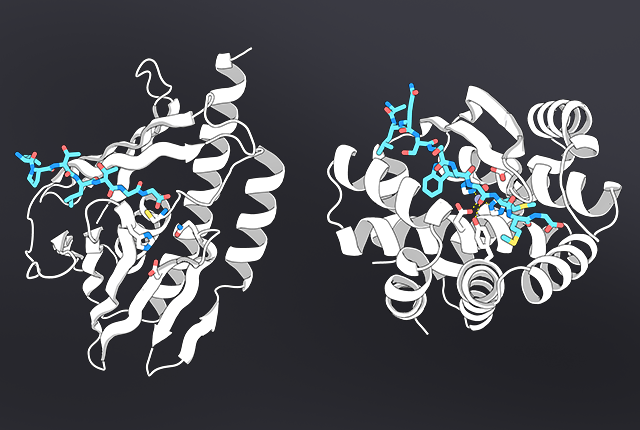
Scientists at the Institute for Protein Design at University of Washington Medicine (UW Medicine, USA) have created AI-designed synthetic proteases: enzymes that act as molecular scissors, cutting another protein at a predetermined, precise site. The researchers specified a target sequence, designed enzymes to cut those targets, and confirmed their precision under several experimental conditions. Both studies were published on October 14, 2026, in the journal Nature as two separate scientific papers — reported by UW Medicine Newsroom and Ars Technica.
Cysteine Proteases: 19% Success, 30 Million Times Faster
The first paper was led by Hojae Choi, a biochemistry graduate student. The team built the enzymes around an activated cysteine "blade": 19% of the designs succeeded, cutting the target sequence 30 million times faster than the uncatalyzed reaction. The resulting proteins took on entirely new folds, unlike any naturally occurring protease.
Metalloproteases: Cutting Amyloid-Beta 100 Million Times Faster
The second paper was led by postdoctoral researchers Anqi Chen and Kejia Wu. This time the cutting "blade" was not an amino acid but a bound metal ion. 36% of the designs showed activity, and they precisely cut the Alzheimer's-linked amyloid-beta protein at the intended target — 100 million times faster than the uncatalyzed reaction.
Not Binding but Cutting: Why Enzymes Work Differently
Most drugs work through binding: a small molecule or antibody attaches to the target, blocking or activating it one-to-one. Because one drug molecule works with one copy of the target, protein drugs are usually given intravenously in large doses — patients receive fluids by drip for hours or live with a port implanted in a vein.
Enzymes, however, work on a different scale: an enzyme modifies the target, releases it, and remains unchanged, ready to work again. A single designed protease can cut thousands to millions of copies of its assigned target over its lifetime. That means a much lower dose is enough for the same therapeutic effect.
"This is a major step for the field of protein design. The field is moving from predicting protein shapes and interactions and building them precisely, to designing mechanisms that physically alter matter at the atomic level — in a targeted and programmable way," said David Baker, director of the institute and 2024 Nobel laureate in chemistry.
Experiments: From Purified Proteins to Living Cells
The researchers tested the new enzymes on purified proteins and on sequences derived from proteins linked to Alzheimer's disease and amyotrophic lateral sclerosis (ALS). In one of the studies, the enzymes were also tested inside living human cells grown in the laboratory.
Deep-learning-based methods were used to design the proteases: structures were developed, screened for their ability to cut the target sequence, and the proteases' structures were confirmed to match the computational models.
"Designing proteases from scratch has been a long-standing challenge. Creating entirely new cysteine proteases that cut exactly the chosen bonds, and seeing them work even inside living cells, is incredibly exciting. This is a step toward designing custom-made molecular scissors," said Hojae Choi, lead author of one of the studies and a biochemistry graduate student at the University of Washington School of Medicine.
"Proteases are just the beginning. We are aiming for a new generation of designed molecules capable of ever more sophisticated effects on biological systems — this opens new possibilities for studying biology and treating disease," said Anqi Chen, co-lead author of one of the papers and a postdoctoral researcher.
Why It Was Hard and What Comes Next
The protease "blade" must be positioned with near-atomic precision for the cutting chemistry, while natural proteases rely on subtle flexibility to "hold" the target sequence. Both of these properties have long been a serious design challenge. The recent breakthroughs came from the improved ability of new computational models to overcome such complexities.
This breakthrough also opens the door to targeting disease-linked proteins that have so far been considered "undruggable" because they lack a "pocket" that traditional drugs could attach to. According to UW Medicine, the functional properties of proteases enable approaches impossible with binding agents: completely destroying a viral protein or bacterial toxin, clearing misfolded proteins that accumulate in neurodegenerative diseases, or cutting off a drug's protective "cap" so it acts only in the needed tissue.
The work was supported by the Howard Hughes Medical Institute, the Audacious Project, Open Philanthropy's Protein Design Improvement Fund, the Schmidt Family Foundation, the Wu Tsai Research Fund, and other sponsors.