
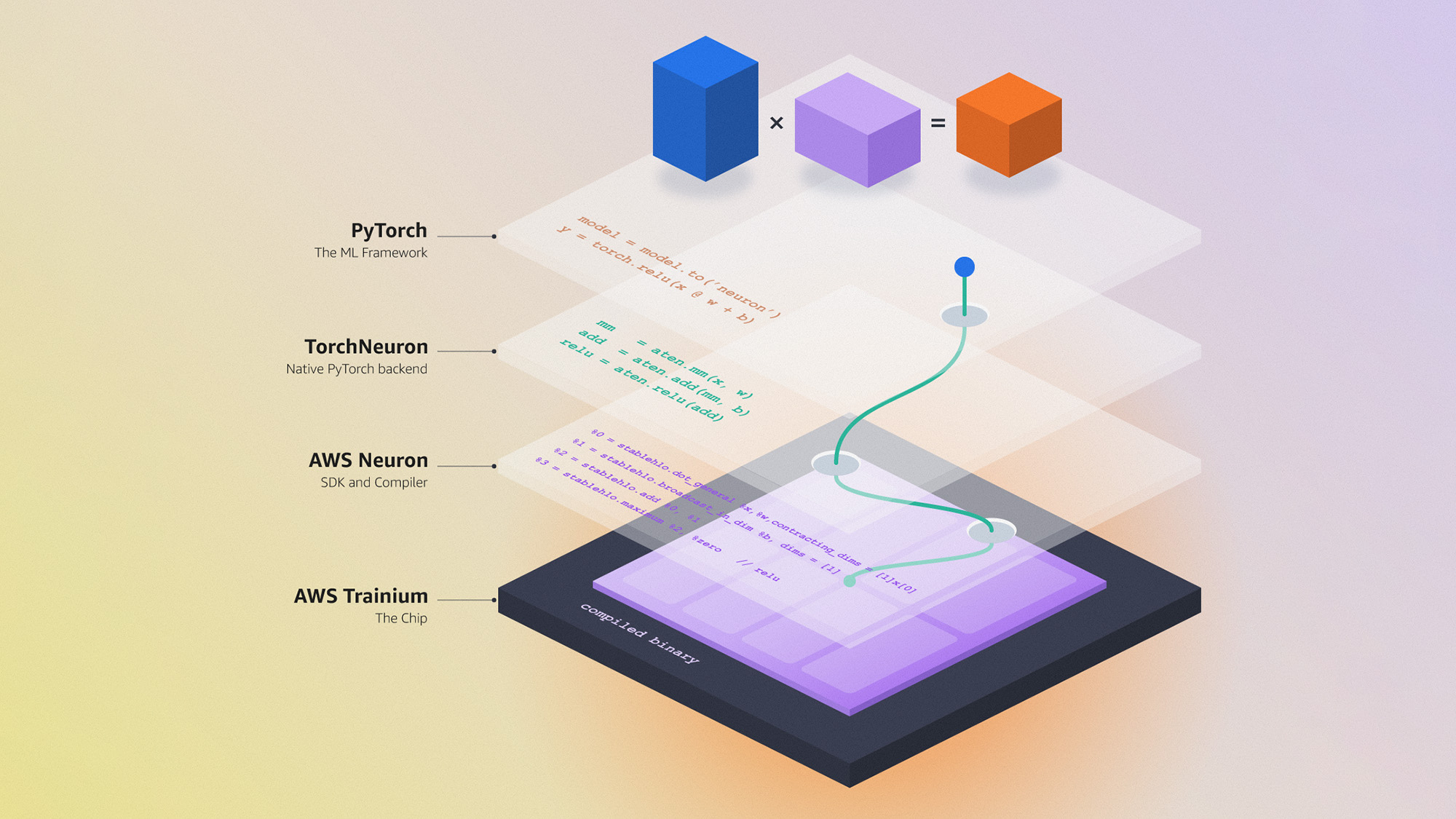
Amazon Web Services released a new software tool called TorchNeuron on October 19, 2026. It lets existing AI applications written in PyTorch run on Amazon's Trainium chips — no code rewrite required; changing a single line of configuration is enough. The tool is distributed free and open source in public beta. According to TechCrunch and Reuters, this is Amazon's biggest attempt yet to challenge the software advantage that underpins NVIDIA's leadership in the AI compute market.
How the Tool Works
TorchNeuron is built to be PyTorch-compatible — meaning a developer who knows PyTorch can start using it immediately without learning anything new. When moving an app to another chip, the code itself is untouched: the developer only specifies which hardware to use in a single line of configuration, and everything else — the tools used for testing, tuning, and scaling — stays unchanged.
This approach matters most for small teams and startups. Rewriting and revalidating an AI application for a new chip is often the most expensive and longest stage; work that in some cases stretches for months shrinks to a one-line change. That is why Amazon initially pitched the tool specifically to AI startups — together with Trainium-based AWS infrastructure. For developers this means TorchNeuron works not as a separate platform but as a natural extension of PyTorch: familiar interface, familiar tools — only the hardware changes.
A Direct Hit on the CUDA Monopoly
According to Amazon, around 85% of AI applications today are written in the PyTorch framework. PyTorch was originally created by Facebook and has been developed as an open-source project under the Linux Foundation since 2022. In recent years NVIDIA has invested heavily in turning its CUDA software platform into the frictionless default runtime for PyTorch applications — making NVIDIA hardware the de facto standard choice in this ecosystem.
TorchNeuron strikes exactly at that point of software lock-in. According to Reuters, by releasing the tool free and open source, Amazon aims to erode the software advantage that sustains NVIDIA's dominance in the AI compute market. Because TorchNeuron is PyTorch-compatible, developers need no new skills to learn it. As Reuters writes, in releasing the tool free and open source, Amazon seeks to move competition precisely onto the software-ecosystem battlefield — the very ground where NVIDIA has spent years entrenching its advantage.
"The real story is removing the lock-in that denied developers a genuine choice," Colin Brace, vice president of software at Annapurna Labs, Amazon's custom chip division, said in an emailed comment to TechCrunch.
Who Is Already Using It
According to Reuters, more than 30 early customers in robotics, world models, and voice AI are already using TorchNeuron. Colin Brace says moving to the new chip can deliver significant cost savings — Amazon's key argument to startups.
Amazon cited voice AI company Deepgram as an example. It migrated to Trainium through TorchNeuron's native PyTorch support and now processes 70% more audio per dollar while maintaining production-level accuracy. TechCrunch notes this example anchors Amazon's price-performance argument against NVIDIA-dependent neoclouds: it is not just about chip price, but about getting more work done on the same budget.
PyTorch Itself Becomes Hardware-Independent
Amazon's plans are not limited to supporting its own chip. According to TechCrunch, the company also plans to contribute changes to the PyTorch project's main codebase — intending to remove code fragments that tie the framework to specific chips. The goal is to make PyTorch hardware-independent not just for Trainium users but for the entire developer community. If the stated goal is achieved, developers will no longer have to rewrite code when a new chip hits the market — the framework itself will be open to any hardware.
The symbolic significance of this move is large: if PyTorch itself is not tied to a particular chip, developers will be free to choose hardware, and chipmakers will have to earn customers' trust with price and quality, not software lock-in. In TechCrunch's assessment, that is precisely why TorchNeuron counts as Amazon's biggest attempt yet against NVIDIA — the fight is no longer on the field of chip specs, but in the software ecosystem developers use every day. Our earlier story on this topic: NVIDIA's open Nemotron 3.5 models.