On October 12, 2026 (Monday), Anthropic announced the results of strengthened safeguards against distillation attacks aimed at copying the capabilities of Claude, its artificial intelligence (AI) models. According to Reuters, the company said the new measures have cut the volume of data stolen in such attacks by roughly 90–99%.
The company's statement says that tougher measures restricting access to the reasoning process have reduced the number of reasoning tokens stolen by distillation actors to 10–100 times fewer than before. Reuters reports that the company specifically noted the 90–99% reduction in the volume of stolen data.
Distillation is a technique in which one model's responses and reasoning traces are collected through mass queries, and another model is then trained on that data. Over the past year, the practice has become a major source of concern for leading AI companies, because it lets competitors reproduce cutting-edge capabilities faster and more cheaply. The company attributes the measures' effectiveness to the 10–100-fold drop in the number of stolen reasoning tokens.
Reuters' October 13 report is based on the company's official statement of October 12. It notes that Anthropic recorded an approximately 90–99% reduction in the volume of data stolen in distillation attacks. The company cites this figure as the key measure of the safeguards' effectiveness.
Protecting the Reasoning Layer
Anthropic has deployed a new security system that restricts access to Claude's protected reasoning process; the system detects malicious queries and prevents them from scaling. The company said it has made it harder to repeatedly probe the protected reasoning process through proxy networks. Such networks make large numbers of queries from a single source appear to come from different addresses; Anthropic has launched mechanisms to block these attempts and hinder large-scale distillation campaigns.
As Reuters emphasizes, the company has taken the number of reasoning tokens stolen by distillation actors as its effectiveness metric. Its 10–100-fold decline reflects the difference between the period before the safeguards were introduced and after.
"The number of reasoning tokens being stolen by those engaged in distillation is now 10–100 times lower than before." — Anthropic (via Reuters)
Anthropic rated the defense system's reliability highly: the company compared its robustness to the systems that prevent Claude from assisting in the creation of biological weapons. At the same time, the system's false-positive rate is noted to be below 0.1%.
"Our safety system is roughly as robust as the systems that prevent Claude from assisting in the creation of biochemical weapons, and its false-positive rate is below 0.1%." — Anthropic (via Reuters)
According to Reuters, the safeguards specifically target restricting access to the reasoning process; the 10–100-fold drop in stolen reasoning tokens is presented as the result of work in this direction.
Tens of Thousands of Accounts Blocked
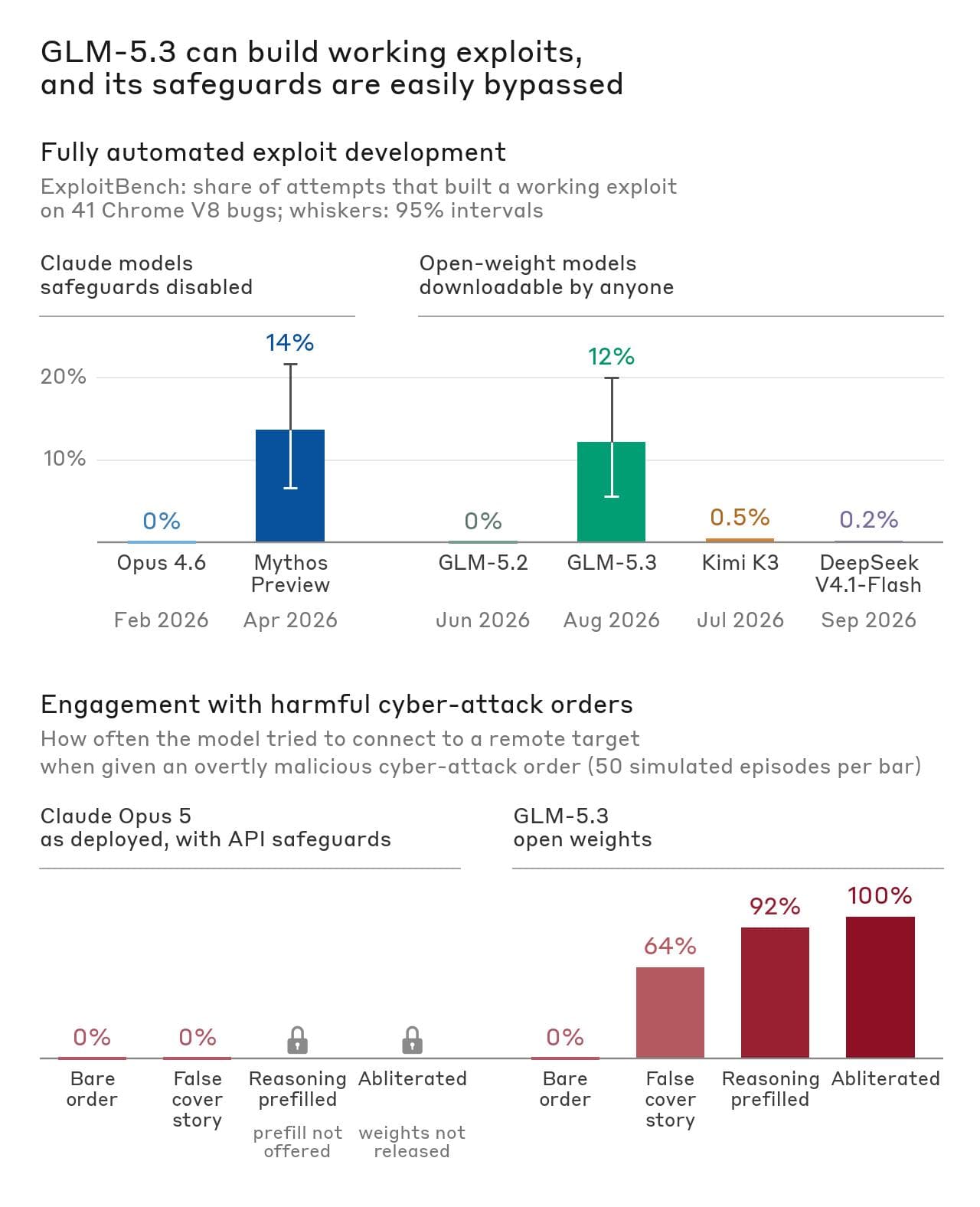
Anthropic confirmed that it has blocked tens of thousands of accounts tied to distillation campaigns. According to Reuters, the company cited China's Z.ai startup (also known as Zhipu) as an example: the company attempted to distill Claude's capabilities while developing its GLM-5.3 model.
Reuters writes that the company cited the Z.ai case as an example of how such practices pose threats to safety and national security. According to Anthropic, all blocked accounts are suspected of taking part in distillation campaigns.
Anthropic applied this measure as part of hindering large-scale distillation campaigns. According to Reuters, the number of blocked accounts runs into the tens of thousands, and all are suspected of participating in distillation campaigns.
Amid U.S.–China Rivalry
Model distillation has become a major concern for leading AI companies amid the intensifying technological rivalry between the U.S. and China. Anthropic, OpenAI and Google share the view that the practice lets competitors reproduce advanced capabilities faster and more cheaply.
Reuters reports that the company presented the results of the new measures against distillation attacks through the 90–99% reduction figure.
Anthropic's official announcement, titled "Strengthening our defenses against distillation attacks", was published on the company's website on October 12, 2026. Reuters' October 13 report brought the details of this announcement to a wider audience.
Reuters writes that the urgency of the distillation issue is tied to the intensifying technological rivalry between the U.S. and China. Anthropic, OpenAI and Google are concerned that the practice lets competitors reproduce advanced capabilities faster and more cheaply. The company's official announcement came out on October 12, 2026, and the Reuters report on October 13; both sources confirm the effectiveness of the measures against distillation attacks.