Exiting stealth with an $11.2M raise
On October 20, 2026, Electric Plant emerged from stealth with two announcements at once: Bombadil, a model that reads plants' electrical signals, and an $11.2 million seed funding round. The round was led by Onto Ventures and Climactic, with participation from Ponderosa, Endeavor Catalyst, Ludlow, Michigan Rise, The Fund, Schox VC and Dug Song. The news was announced in an official press release on Business Wire and covered in depth by TechCrunch. Until that day the company had made no public statements about its work — which is why its debut was framed as an "emergence from stealth."
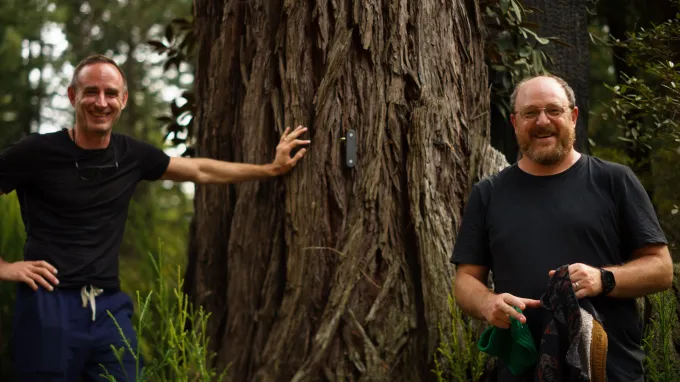
The company was founded in 2023. Its founders are CEO Justin Mast and chief scientist Lee von Kraus. Mast's previous company, Bloomscape, was an online plant retailer. Von Kraus holds a PhD in neuroscience, has worked with DARPA and NASA, and previously founded Halo Neuroscience. Both founders' backgrounds are highlighted in the press release. The participant list includes the funds Ponderosa, Endeavor Catalyst, Ludlow, Michigan Rise, The Fund, Schox VC and Dug Song.
The news broke in two places at once: the company's official press release was published on Business Wire, while TechCrunch covered it with a detailed article. Both sources are dated October 20, 2026.
Bombadil: the first AI foundation model for plant electrophysiology
The company's headline announcement is the Bombadil model. The press release describes it as the first AI foundation model built for plant electrophysiology. The model was trained label-free: more than 4 million hours of electrical recordings from over 1,400 plants across more than 100 species were used for pretraining without manual human labeling. The press release calls Bombadil "the first AI foundation model for plant electrophysiology" — a claim presented as the company's own statement.
"The company debuted Bombadil, described as the first AI foundation model for plant electrophysiology, pretrained without labels on more than 4 million hours of electrical recordings from over 1,400 plants across 100 species." — Electric Plant press release, Business Wire
Bombadil analyzes electrical signals in plant tissue and evaluates seven physiological stress markers. In other words, the model decodes raw electrical recordings and converts them into seven metrics reflecting the plant's physiological state. Markers disclosed in the press release include photosystem II efficiency, leaf temperature relative to ambient air temperature, and the Crop Water Stress Index (CWSI). The company stresses that all of these metrics are derived solely from the electrical signal — with no separate optical or chemical measurements. CEO Justin Mast told TechCrunch that Bombadil can interpret the electrical signals of nearly 125 different plant species — above the 100 species used in pretraining — presented as the company chief's claim.
The Bud sensor: attaches directly to the plant
Alongside the model, the company showed off a sensor called Bud. The sensor attaches directly to the plant and records electrical signals from its tissue. According to TechCrunch, the sensors are about the size of a standard iPhone folded lengthwise. They are fastened to the plant with stainless steel screws — the screws enter the cambium layer, through which the tissue's electrical activity is recorded. The recorded data is transmitted to a base station over a low-power wireless network. The signals recorded by the Bud sensor are analyzed by the Bombadil model.
The sensor's main advantage is price: while existing professional equipment costs thousands of dollars, the Bud sensor costs tens of dollars — TechCrunch highlights this price gap as one of the story's key takeaways. CEO Justin Mast claimed the system could raise yields and cut water use by 20% or more. These figures are likewise published as the company chief's claims — they appear in the press release and the TechCrunch article and are not presented as independently measured results.
Technical whitepaper and early deployments
Electric Plant has published a technical whitepaper documenting how Bombadil works — the document was released openly by the company. According to the company, the first deployments are already running at commercial sites: hundreds of sensors are currently installed in the field, collecting data under real-world conditions. That is, the sensors are being tested on working farms in genuine field conditions.