What the Gemini Agent Does
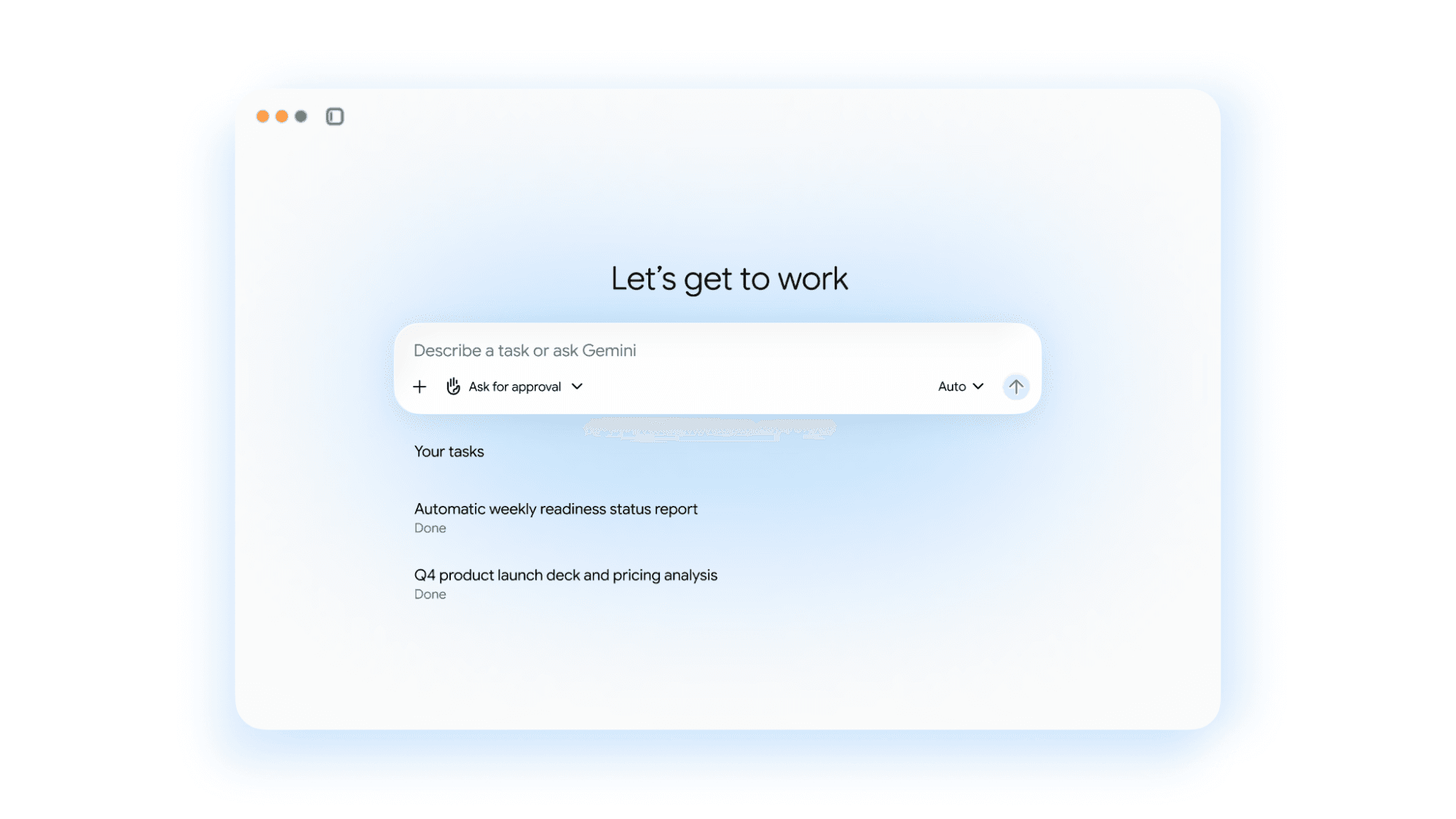
Google Cloud unveiled its universal AI agent for work — the Gemini agent — at the «Gemini at Work 2026» event on October 8, 2026. The agent answers questions from a single prompt window, performs knowledge work, creates images and media content, and writes and runs code. Google Cloud CEO Thomas Kurian summed up the agent's purpose in one sentence: "Work now starts with the prompt window" (Google Cloud blog).
The Gemini agent is given outcomes, not instructions. The user sets the goal — the agent plans the work, uses the necessary skills and tools, connects to company systems, and returns the finished result. It can act as a personal assistant or as a team member: for example, performing the role of a project manager or a finance analyst.
Architecture Principles
Google Cloud built the agent on four core principles. First — unity: Gemini answers questions in conversation, autonomously completes assigned goals, and generates code — all through a single interface. Task planning and event responses happen in the same window.
Second — availability everywhere. The agent is accessible via web, iOS and Android mobile devices, and Windows and Mac desktops. It works across channels such as the command line, Google Workspace, Microsoft 365, and Slack, attaches to third-party apps, and operates even in headless mode without a separate interface.
Third — continuous execution. The agent runs in the cloud, so it maintains a single memory, context, and personalization graph. Even if the user closes their laptop, work that lasts hours or days doesn't stop — everything is in place when they return.
Fourth — multi-agent orchestration. Gemini doesn't work alone: for multi-step tasks, it dynamically creates temporary specialized sub-agents and coordinates the workflow between them. These agents can run in parallel or in sequence — for hours or days.
Coworker Agents and Model Selection
The standout part of the announcement is "coworker agents". The user describes the needed role, and Gemini creates it as a team member. Such an agent gets its own email address, calendar, and Drive storage, and appears in the company directory. Importantly — it only has access to the data assigned to it. Colleagues can add it to a Chat group or summon it with an @mention in document comments.
Industry specialization was also introduced: versions for financial services and legal work are now in preview. Versions for the public sector, healthcare, and retail will follow in the next phase.
The Gemini agent itself and the model under it are selected separately. The agent runs each task on the most suitable model: currently Google's Gemini model family and Anthropic's Claude models are used, with other leading closed and open models to be added in the future. Google ties this to cost control: matching the model to the task improves accuracy on hard tasks and lowers the price on simple ones.
Skills, Tools, and Memory
Gemini's understanding of business rests on three capabilities: tools that connect to systems, skills that teach how work is done, and context that enables remembering. The agent securely connects to apps like Confluence, Microsoft Office, Teams, Slack, Git, Jira, Salesforce, BigQuery, and PostgreSQL, and can work with any Model Context Protocol (MCP) server. Skills are modular command sets that teach how to perform multi-step tasks; teams publish them to a shared company catalog.
Memory is stored in four types: session memory for the current task, semantic memory gathered from documents and conversations, procedural memory that remembers how work is done, and episodic memory — the history of all previous actions. As a result, Gemini, like a new employee, learns the user, their tools, and their team "before becoming trusted".
Working Inside Workspace and Enterprise Metrics
Thomas Kurian noted at the event that enterprises moved from experimentation to practice over the past year:
"Over the past year, nearly 500 of our customers each processed more than a trillion tokens. At this scale, organizations have moved from experimenting to running their business on it," said Thomas Kurian, Google Cloud CEO (Google Cloud blog).
Gemini works directly inside Gmail, Drive, Docs, Slides, Sheets, Chat, and Calendar — memory, skills, and governance settings stay consistent everywhere. It operates in three modes: personal assistance (knows the calendar, team, and projects in advance), proactive delegation (suggests tasks that could become assignments), and working as a team member (via coworker agents).
Enterprise-scale numbers were also announced. Over the past year, nearly 500 Google Cloud customers each processed more than a trillion tokens. Currently nearly 80% of Google Cloud customers use its AI products, while nearly 90% of Fortune 100 companies use Gemini Enterprise.
The announcement landed amid intensifying competition among tech giants to sell autonomous AI. According to Reuters, OpenAI released its always-on dots agents in September, while Meta introduced its personal Muse agent. Google Cloud's answer is a single agent with enterprise-grade security, governance, and control.