
MAI-DxO (diagnostic orchestrator), developed by Microsoft researchers, correctly diagnosed 83% of complex cases from the New England Journal of Medicine in a simulation, according to a study published in Science on October 22, 2026. For comparison, general practice physicians (primary care doctors and general internists) working alone with reference materials achieved only 36% accuracy. Microsoft AI chief Mustafa Suleyman called the result a step toward “medical superintelligence,” the goal the company is pursuing.
How the Test Worked
MAI-DxO is a system combining several AI agents: they work like a panel of physicians — questioning the patient, ordering tests, and debating the diagnosis among themselves. In the test, it was this “panel” that diagnosed complex clinical cases more than twice as accurately as solo physicians.
There is an important caveat, though: as the researchers themselves emphasize, such complex cases are usually handled by specialists or a team of physicians — yet they did not take part in the comparison. So reading the 83% and 36% figures as “AI beats all doctors” would be wrong — the comparison is with general practice physicians working alone. It is also worth remembering that the test ran in a simulation — DxO worked not with real patients but with written cases published in NEJM. The result shows the system’s capacity for complex diagnostic reasoning, but it does not mean it can be carried directly into clinical practice.
Cost and Models: Where the System Is Strong and Where It Isn’t
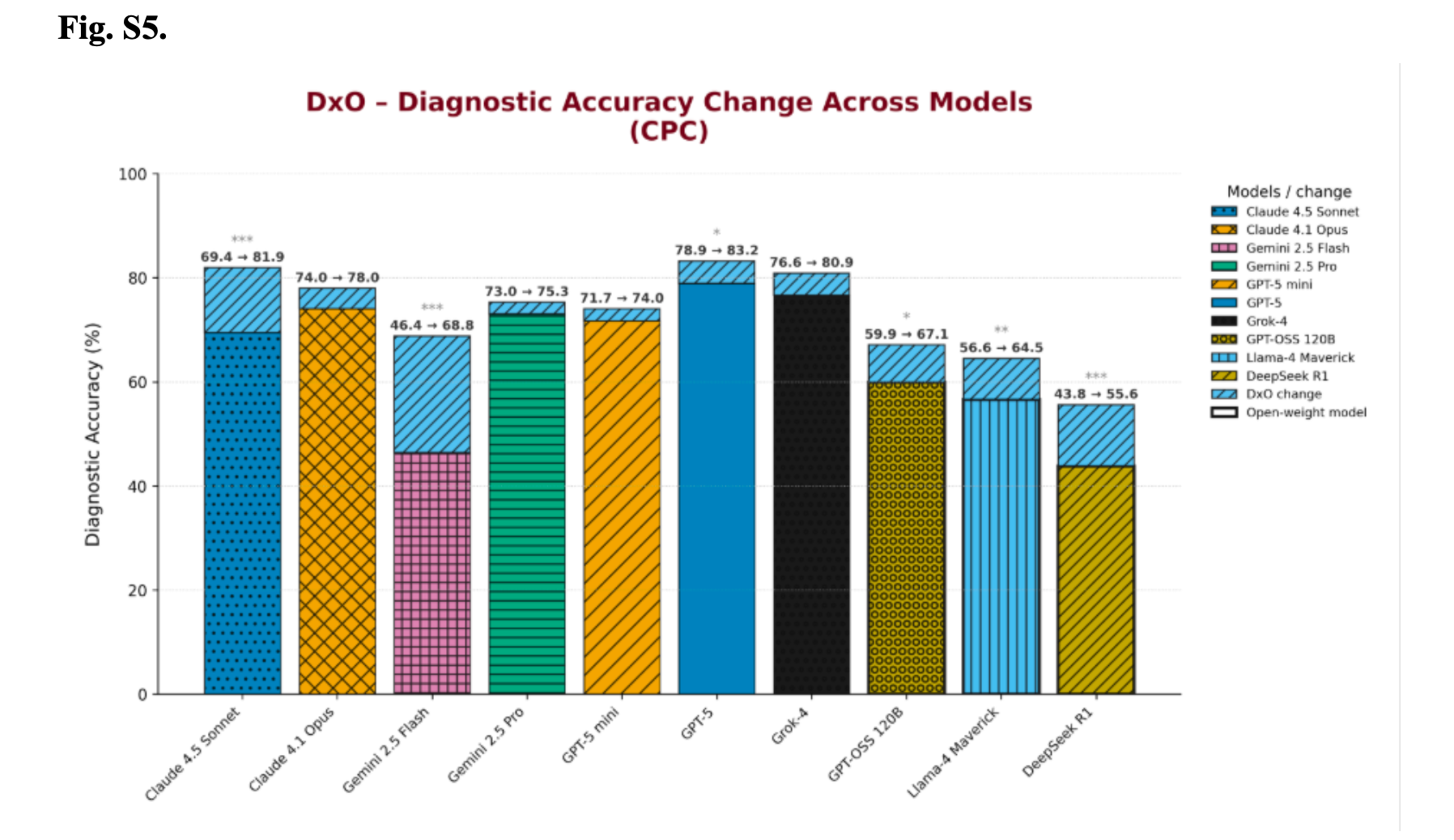
The researchers tested DxO on models from several companies. The best results came on OpenAI’s GPT-5 and GPT-5.5 models.
Working with GPT-5, DxO cut the cost of each case by roughly $3,000 while raising accuracy by about four percentage points. With the newer GPT-5.5, the result was strikingly different: DxO lifted accuracy from 72% to nearly 87% — at a slightly lower cost.
But the system’s limits were also clear. In emergency department cases, DxO added almost no benefit — both accuracy and cost came out similar to the no-DxO baseline. The researchers also note that the benefit of the orchestration layer shrinks as models approach their theoretical maximum: most of the improvement comes from the stronger base models themselves, with orchestration adding gains on top. Still, the gap between strong and weak models remained larger than the advantage DxO provided. In other words, DxO’s future depends heavily on the base models themselves: while orchestration delivers a significant edge today, its share will keep shrinking as models improve.
“Medical Superintelligence” and Next Steps
Microsoft defines “medical superintelligence” as follows: “the ability to outperform the strongest contemporary human-led healthcare systems in medical reasoning and coordination across the full continuum of care.” The company wants to move beyond evaluating isolated tasks — like answering medical exam questions or making a single diagnosis — and achieve better outcomes by integrating AI with clinicians and health systems. This definition is worth noting: Microsoft is not aiming for superiority in a single task like making an individual diagnosis, but to surpass human-led systems across the entire chain — from patient intake to care coordination. In other words, the yardstick is not one test, but the overall effectiveness of the healthcare system.
Next steps are moving in two directions. First, Suleyman said Microsoft is preparing a healthcare foundation model together with Mayo Clinic — with a release planned for next year. Second, under a new partnership with Beth Israel Deaconess Medical Center in Boston, DxO’s clinical reasoning will be evaluated in a real hospital setting — in parallel with standard human care. Patients who consented to the study receive standard treatment and simultaneously “work” with DxO — the system’s recommendations are then compared against the conclusions of human physicians. This parallel design was chosen for patient safety: participants receive full standard care while DxO operates independently alongside — its conclusions do not affect treatment; they are only later compared with the physicians’ findings.
The system remains a research project for now — the parallel trials at the Boston hospital are just getting underway, and no results have been published. So MAI-DxO’s effectiveness in real clinical practice is still unproven.
The Verge also confirmed the news on October 22 — citing Microsoft’s Science study, it noted the diagnostic tool’s edge over physicians and interpreted the results as infrastructure on the road to “medical superintelligence.”