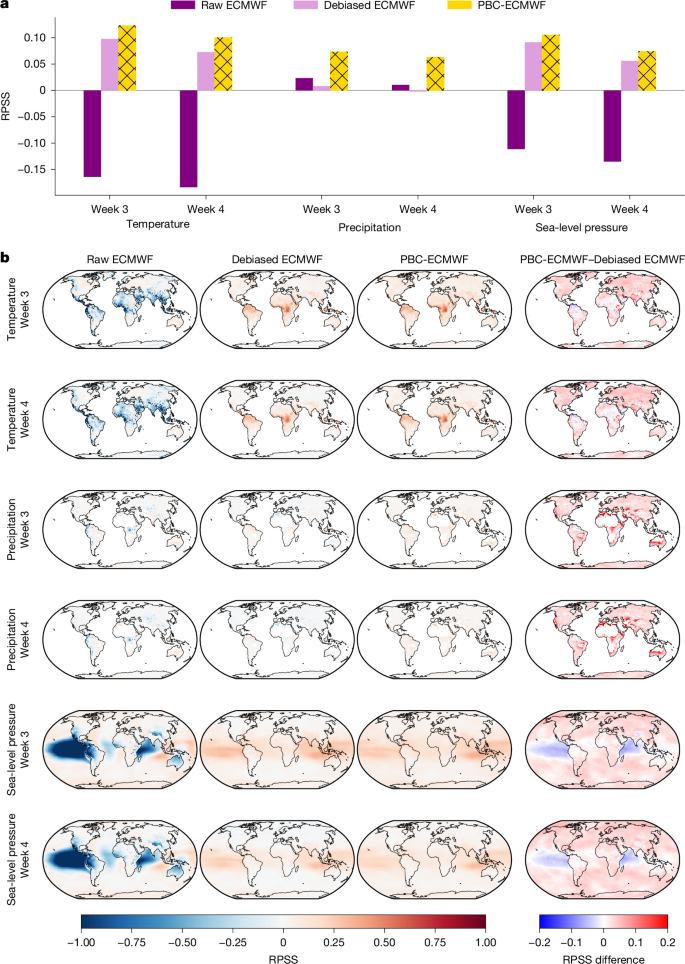
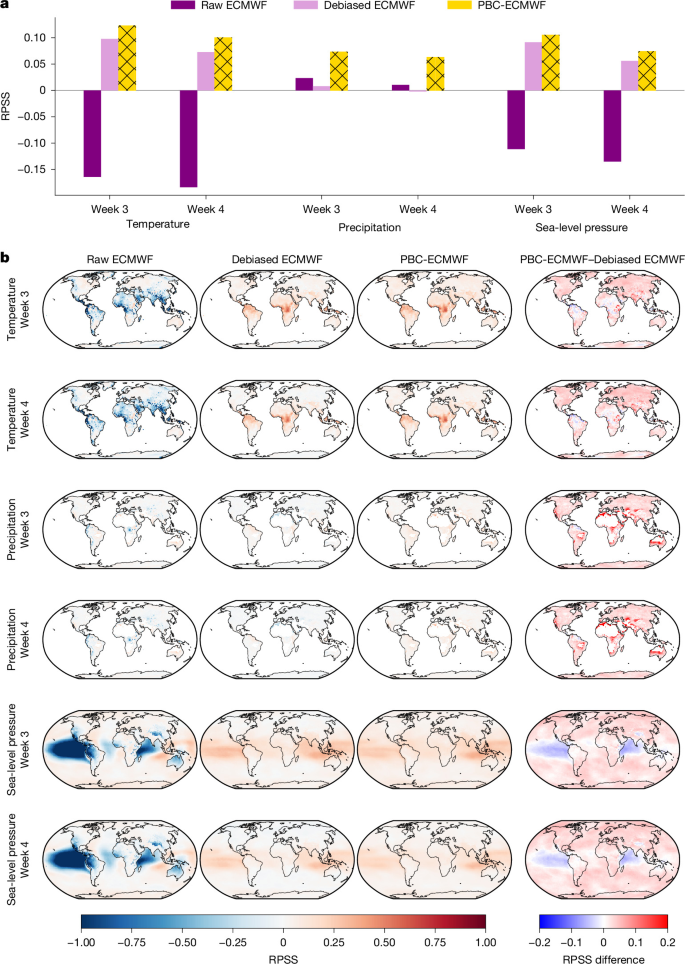
In a paper published on October 14, 2026 in the scientific journal Nature (DOI 10.1038/s41586-026-11126-x), an international team of researchers introduced a new system called PBC (probabilistic bias correction). PBC is a lightweight machine-learning-based system designed to correct systematic errors in existing weather forecast models; it improves probabilistic forecasts on the subseasonal horizon of 2 to 6 weeks. The team was led by Harvard student Hanna Guan and includes researchers from Microsoft Research, the Massachusetts Institute of Technology (MIT), the European Centre for Medium-Range Weather Forecasts (ECMWF), and other scientific institutions. According to the paper, applying PBC to ECMWF's AI-based AIFS-SUBS forecasting system doubled its average subseasonal skill.
Results in ECMWF Models
The team applied PBC not only to AI models but also to ECMWF's operational dynamic ensemble. This ensemble is a traditional numerical-modeling-based system with operationally corrected bias and is considered one of the most reliable sources of forecasts in global practice. According to figures in the Nature paper, after PBC was applied, forecast skill improved in 91% of grid cells for pressure, 92% for temperature, and 98% for precipitation. These indicators are based on a global assessment covering 2016–2024.
MIT researcher Judah Cohen told MIT News:
"Until now, no one had been able to show that a model could forecast on subseasonal timescales better than long-term averages. Our models consistently outperform climatological averages."
Cohen added that the method also statistically significantly improved the ability to predict extreme weather events — floods or cold waves. This matters in particular because ECMWF's traditional, non-AI-based bias correction method had actually worsened results when forecasting extreme events.
The original author of the idea is Microsoft Research scientist Lester Mackey, who has collaborated with MIT researcher Judah Cohen for over a decade. Leading authors of the paper include Harvard student Hanna Guan, University of Toronto postdoc Sukayna Muatadid, MIT scientist Genevieve Flaspohler, and ECMWF researchers Yakob Shlyor and Joshua Talib.
Victory in the AI Weather Quest Competition
The method's practical effectiveness was put to the test in 2025 in ECMWF's real-time AI Weather Quest forecasting competition. Models from operational forecasting centers around the world took part. PBC-based forecasts took first place across all weather variables and all forecast lead times — a result also covered by The Verge.
The researchers note that the winning solution combined ECMWF's forecast model with another model and applied the PBC correction on top. This approach doubled the base model's predictive power in the subseasonal range and for the first time delivered results better than long-term average benchmarks. The competition ran in real time — models predicted future weather in advance, and the results were verified later.
Open Code and Accessibility
Another important aspect of PBC is its openness and lightness. The method's full code is published openly on GitHub (mouatadid/pbc), so other research groups and forecasting centers can attach it to their systems as an additional layer and try it out. Although the model was created using MIT's Engaging supercomputer cluster, running the finished system does not require a supercomputer.
According to the authors, PBC can work with any incoming model and even further improves models whose bias was already corrected by another AI algorithm. This allows the method to be transferred to various forecasting systems.
Why Subseasonal Forecasting Is a Special Range
Subseasonal forecasting means predictions targeting horizons of 2 to 6 weeks. Short-term forecasts (1–2 weeks) are now fairly accurate, but beyond the two-week mark even small differences in initial conditions lead to sharply divergent outcomes. That is why probabilistic forecasts are used in this range instead of a single exact value — the distribution of possible states of future weather is predicted. PBC corrects systematic biases precisely in these distributions, learning from the model's own historical forecasts and past weather observations.