Bengaluru-based startup Scimplify has raised $25 million in an all-equity strategic round led by Hitachi Ventures, TechCrunch reports. The round is aimed at expanding the company's AI-assisted specialty chemicals and critical materials manufacturing. New investors include the company's own customers — Henkel and Teknor Apex. Existing investors Accel India, Bertelsmann India Investments, Omnivore, and 3one4 Capital participated in the round. Citing a source familiar with the deal, TechCrunch writes that the startup was valued at $250 million after the investment — well above the $150 million valuation following its $40 million Series B in March 2025. The round brings the company's total funding to $80 million.
Round details
Notably, this financing stage — described as a strategic round — saw customers participate as investors. Henkel and Teknor Apex are already Scimplify customers; their decision to also contribute capital strengthens the company's position in specialty chemicals and critical materials. According to a source familiar with the deal, the post-round $250 million valuation is significantly higher than the $150 million valuation after the $40 million Series B in March 2025. The startup itself did not disclose the valuation figure — the $250 million number was reported by TechCrunch citing a source familiar with the deal.
According to TechCrunch, the round was fully equity-based (all-equity) and was led by the venture fund of Japan's Hitachi Ventures. Among the new investors, the notable detail is that the company's customers Henkel and Teknor Apex joined as investors — showing these manufacturers already use the Scimplify platform. Existing investors Accel India, Bertelsmann India Investments, Omnivore, and 3one4 Capital also participated in the new round. Scimplify's official website corroborates the financial facts: it shows $80 million in total funding raised, and its investor list includes Accel, Hitachi, Teknor Apex, and 3one4 Capital. About $7.5 million of the raised funds will go toward US market expansion, with another $2 million spent on further developing the Scinode AI platform. Reporting on the $25 million round size relies mainly on TechCrunch — the official site only announced the $80 million total and the investor lineup.
Scinode — AI-driven manufacturing
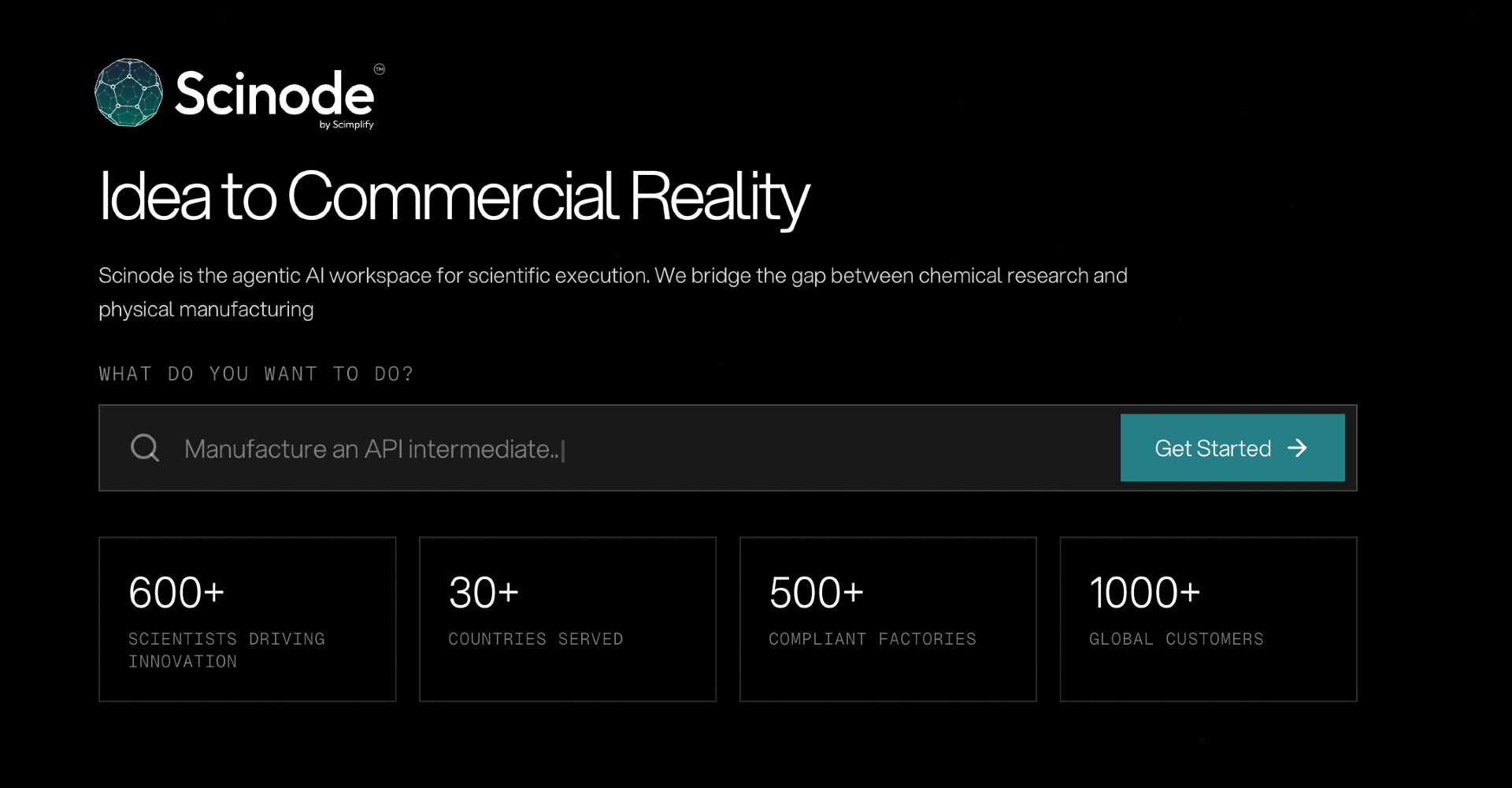
Scimplify's key technological advantage is its proprietary Scinode AI platform. The platform identifies production routes and suitable factories for a customer order while tracking quality and regulatory requirements. Inside Scinode, specialized AI agents handle distinct functions: research, production, and quality control. Each agent shapes a solution tailored to the customer's needs based on their requirements.
Each specialized agent of the Scinode platform is responsible for its own domain: research agents focus on identifying production routes, production agents on selecting suitable factories, and quality-control agents on tracking quality and regulatory requirements. This approach makes it possible to choose the most suitable path for chemical manufacturing based on customer requirements.
Scinode — "AI powering every node from science to manufacturing." — Scimplify official site, scimplify.com
The platform works like this: when an order arrives, Scimplify develops chemical manufacturing processes at research facilities in Bengaluru and Hyderabad, then transfers them to partner factories for commercial production. Scinode helps coordinate this work by selecting suitable production routes and factories and tracking quality and regulatory requirements.
An alternative to Chinese supply and company scale
Scimplify positions itself as an alternative source for materials whose supply is concentrated in China. The company is working on producing tungsten derivatives from secondary raw materials (scrap) — an important feedstock for the semiconductor industry. The startup is also active in rare-earth materials, a category whose global supply chains are likewise heavily dependent on China. Customers include semiconductor, defense, and energy companies — precisely the sectors most sensitive to disruptions in critical materials supply.
Despite being founded in 2023, the company has built a wide network in a short time: more than 500 partner factories, over 1,000 customers, and products delivered to more than 40 countries. The raised $7.5 million will fund US market expansion, including growing the manufacturing network, while $2 million will go toward further improving the Scinode platform.
The company was founded in 2023 and is headquartered in Bengaluru. Its manufacturing network covers more than 500 partner factories, it serves over 1,000 customers, and its products are delivered to more than 40 countries. As TechCrunch notes, the company is paying special attention to US expansion; details are also published on the official site.