
How the Site Works
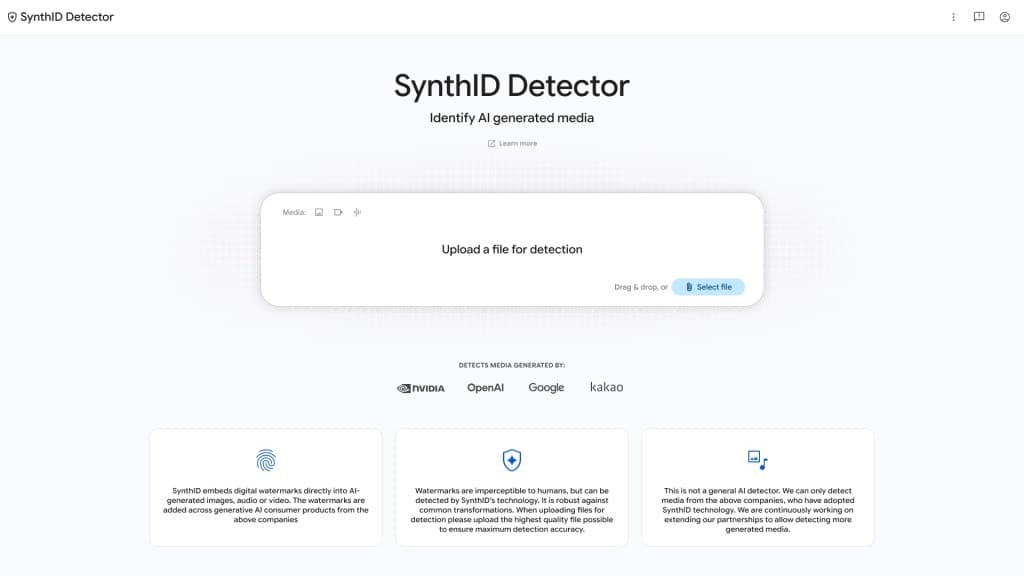
On October 7, 2026, Google launched a new website at synthid.com. All it takes is uploading any image, video, or audio file — the system detects whether the file carries a SynthID digital mark and reports whether it was created with the help of artificial intelligence (AI). The check runs entirely in the browser; no separate software installation is required. This is the first public version of a tool that until now was available only to selected journalists, media professionals, and researchers: the detector was introduced in test mode at last year's Google I/O 2025, and access is now open to everyone worldwide.
The results page clearly shows whether the file is marked with a SynthID mark. For files where a mark is found, the system reports that the likelihood of AI-assisted creation is high. This is one of the first open tools designed for quickly determining content provenance.
Which Formats Are Supported
The site accepts three media types. For images — 11 formats: JPG, JPEG, PNG, BMP, WEBP, AVIF, HEIC, HEIF, TIFF, TIF, and GIF. For videos — 3: MP4, MOV, and WEBM. For audio — 6: WAV, MP3, OGG, FLAC, AAC, and M4A. The format list is openly displayed on the site's homepage — users can drag a file into the browser or upload it manually. Broad format support makes the detector practical for everyday use: anything can be checked, from a smartphone photo to a professional video-editing file.
About SynthID Technology
SynthID is a digital watermarking technology Google introduced in 2023. It embeds an invisible digital mark in every media file produced by the company's generative models — such as Nano Banana, Veo, and Lyria — as well as in content-creation tools like Gemini, Flow, ProducerAI, and Vids. In other words, every media file created in these models and tools since 2023 carries the invisible mark. The mark cannot be seen with the naked eye, but a dedicated detector reliably identifies it. Even if a marked file is edited later, the mark usually survives.
Where It Is Already Used
SynthID verification is already built into Google's core products. According to the company, 1 million verification requests are sent daily through the Gemini app and the Chrome browser — meaning verification is actively used at everyday scale. The new synthid.com site presents this capability as a separate, standalone interface — verification no longer requires Gemini or Chrome; a standalone page in the browser is enough.
The technology has moved beyond Google: OpenAI, Nvidia, and Kakao also support SynthID. That means content created in these companies' tools is also marked with a SynthID mark and can be verified through the new site. A single detector now covers files created by models from multiple manufacturers.
Why This Matters
As the volume of deepfakes and AI-generated material grows, demand is rising for tools that quickly verify content provenance. The public opening of SynthID gives media organizations, journalists, and ordinary users the ability to independently check suspicious files — with no special software or technical knowledge required.
The timeline is as follows: SynthID was introduced in 2023, tested in 2025 at Google I/O with selected journalists and researchers, and on October 7, 2026 opened to everyone worldwide via synthid.com. The result of three years of development now runs in any user's browser.
The technology has limits, too. SynthID only detects marked content — files without a mark or with a removed mark can slip past the detector. So a detector result should be treated not as a final verdict, but as a supplementary verification tool.
Industry Backdrop
Ars Technica described the news this way:
Google rolled out an improved SynthID AI content detector that is now available globally.
Google's public site has become one of the first broadly open detectors in this field. As TechCrunch notes, Google tested the detector at last year's I/O 2025 with selected media professionals and researchers — meaning the tool went through a real-user testing phase before the public release, and the current open version is a continuation of that testing.
Detector Limitations
Such tools are not perfect. SynthID only detects marked content — files without a mark or with a mark removed later can slip past the detector. Detector results should therefore be used not as a final verdict but as a supplementary verification tool — the detector's conclusion is compared against other evidence.