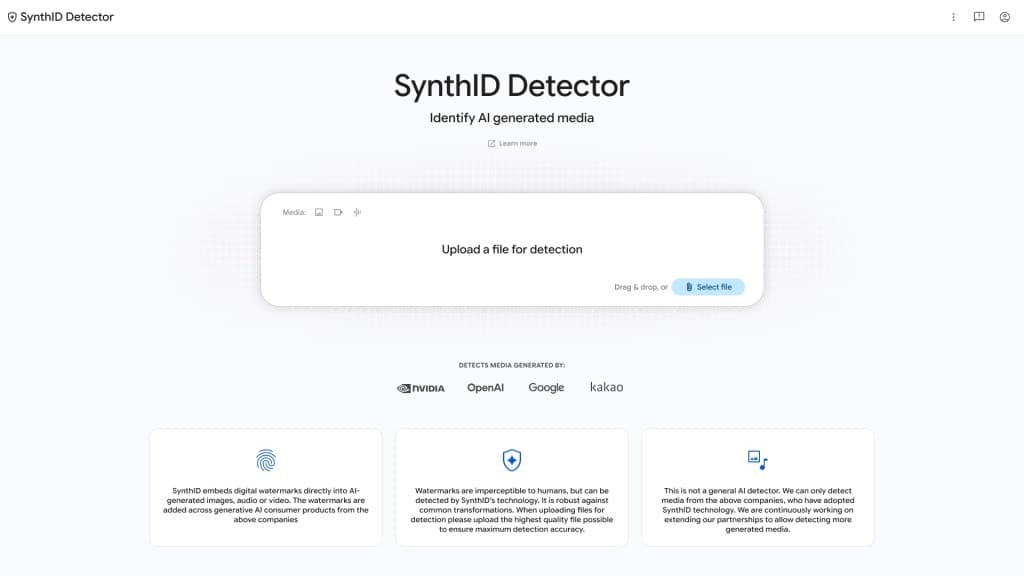
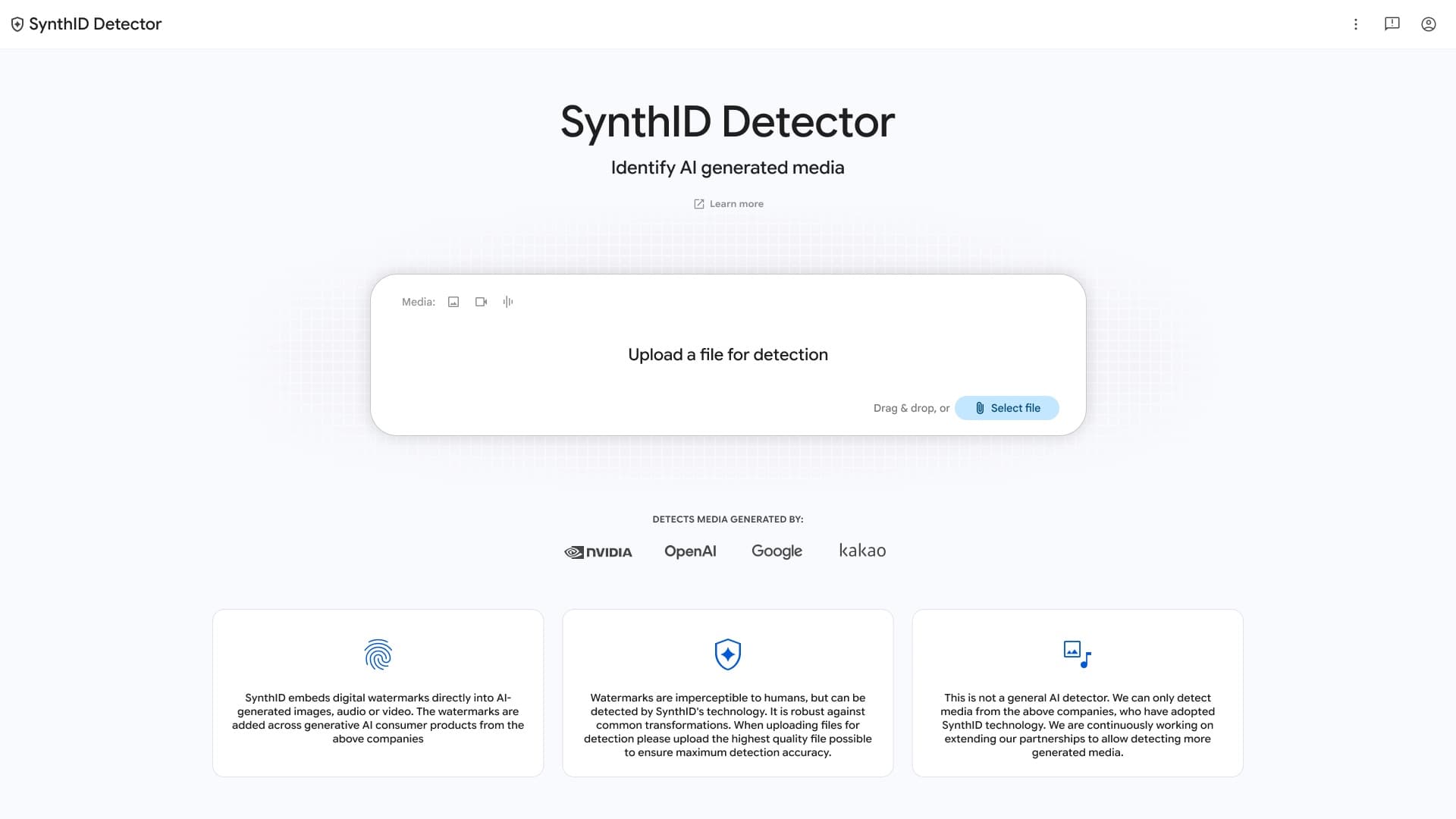
On Tuesday, October 7, Google opened to everyone a website that checks media files created by artificial intelligence. Anyone can upload an image, video, or audio clip to the new portal and learn whether it carries a SynthID watermark — that is, whether the file was created by Google's AI models.
The detector was announced by Google DeepMind at the Google I/O 2025 conference. Back then, access went only to selected journalists, media professionals, and researchers; now any user can check a file. The portal shows the verification result together with where in the file the watermark was found — the uploaded file and the result appear on a single page.
Supported Formats and How It Works
Once a media file is uploaded to the portal, the system searches it for the invisible SynthID watermark. If a watermark is found, the portal shows which parts of the file were most likely AI-generated — for example, it highlights watermarked areas on an image and marks watermarked segments in an audio file. This lets users see exactly which part of a file was machine-made.
The site supports the following formats: JPG, PNG, WEBP, AVIF, HEIC, TIFF, and GIF for images; MP4, MOV, and WEBM for video; WAV, MP3, OGG, FLAC, AAC, and M4A for audio. According to TechCrunch, the list also includes JPEG, BMP, HEIF, and TIF variants. Nearly every media format encountered in daily life can therefore be submitted for checking. The listed formats are the most-used on phones, cameras, and social networks, making the portal handy for checking everyday media streams.
Ars Technica reports that Google simultaneously rolled out its improved SynthID detector globally.
Where the SynthID Watermark Is Applied
SynthID is an invisible-watermarking technology for AI-generated content introduced by Google DeepMind in 2023. The mark is invisible to the eye, but a dedicated detector can read it.
According to Google, the SynthID watermark is now applied automatically in the Nano Banana, Veo, and Lyria models, as well as in tools with generation capabilities — Gemini, Flow, ProducerAI, and Vids. That means any image, video, or audio file created with any of these models automatically receives the invisible mark and can later be verified through the portal. OpenAI, Nvidia, and Kakao also support the standard; OpenAI runs its own separate checking site. Apple is expected to add support soon as well.
How It Was Announced
Google announced the portal on Tuesday, October 7 — the TechCrunch story went out that morning at 7:00 a.m. Pacific time. According to the publication, the company opened the site to the general public. Ars Technica wrote the same day about Google's global rollout of the improved detector.
Before that — at Google I/O 2025 — the detector had been given to selected journalists, media professionals, and researchers for testing. After the trial period, access was opened without restrictions.
Google's Numbers: One Million Checks a Day
Google has built SynthID verification into the Gemini app and the Google Chrome browser. According to the company, people now send one million content-verification requests per day. TechCrunch reports the current volume of verification requests has reached one million daily. Embedding the feature in the Gemini app and Chrome means it can be used without opening the portal separately — an image seen in the browser or a file in the app can be checked right in that same environment.
According to Google, users send one million requests a day to check whether media files were created by artificial intelligence. The verification feature is built into the Gemini app and Google Chrome. — TechCrunch, October 7, 2026
Competition and Limitations
Google's approach is not the only solution on the market. Microsoft and Meta are developing their own watermarking and verification standards. At the same time, Reuters reports such tools are not infallible — they often fail to identify even content created by their makers' own models.
SynthID detects exactly watermarked files: if content was created by another company's model or a tool without SynthID support, the detector will not find it. The portal is therefore treated as an additional tool for spotting AI content, but not as the single source of a final verdict. The detector's reach is limited to the ecosystem where watermarks are applied — it cannot determine the origin of an unwatermarked file.