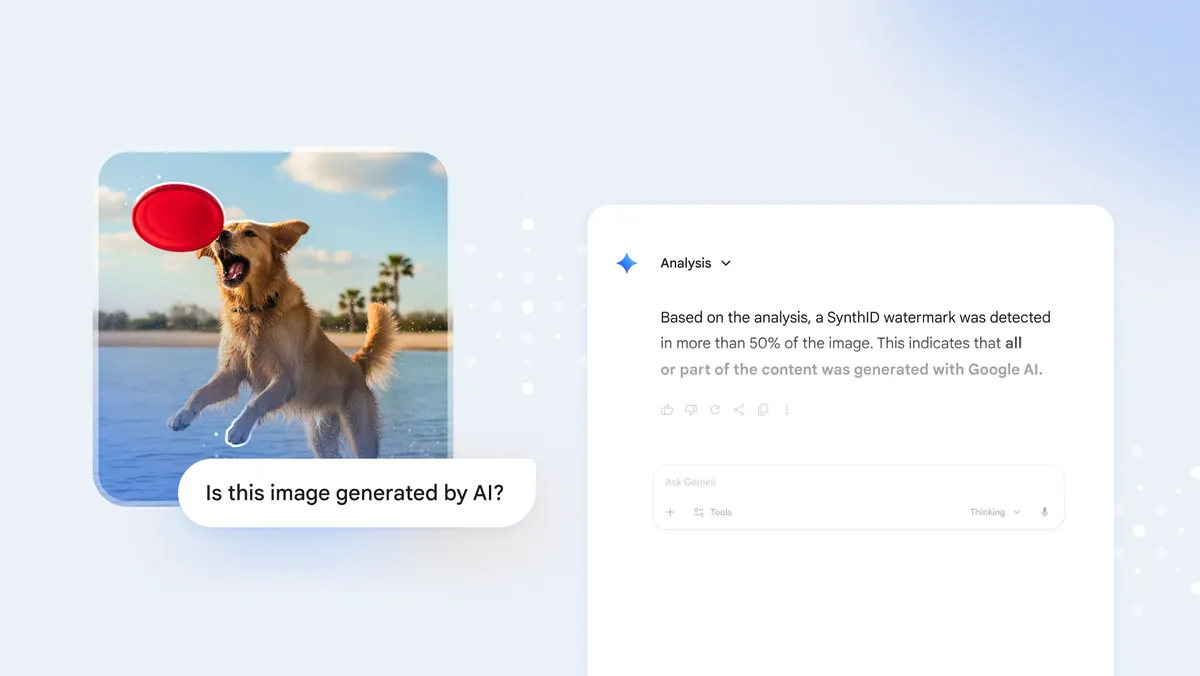
Google's SynthID technology has been included in TIME magazine's 2026 best inventions list. The company announced the news on October 15, 2026, in its official blog. SynthID is a system that applies an invisible digital watermark to AI-generated content; TIME included it in the list for its novel approach to AI watermarking and verification.
Why a Watermark Is Needed
Generative AI media is becoming increasingly realistic — it is growing harder to tell a genuine photograph apart from an AI-generated image with the naked eye. According to Google, knowing how content was created helps people navigate the internet with confidence. This very problem led to the creation of SynthID: the system "embeds" provenance information directly into the content itself.
Traditional solutions — such as metadata attached to a file — are easily lost when content is copied or edited. SynthID's key difference is that the mark is embedded in the content itself and does not depend on external records. It can therefore survive in copies shared across the internet.
How SynthID Works
SynthID applies an invisible, robust digital watermark to AI-generated images, audio, video and text at the moment of creation. Watermarking does not change content quality — images look and audio sounds the same as before, yet a dedicated tool can detect the mark later.
Invisibility matters because the mark is imperceptible to human senses: viewers see no trace in an image, listeners hear no difference in audio. Nonetheless, the algorithm can detect the mark's presence and identify which system applied it.
According to Google, SynthID has so far marked more than 180 billion images and videos and 240,000 years of audio recordings. The figure shows the technology already operating at industrial scale: marks are automatically applied to content generated across Google's ecosystem. The numbers mean the system has moved past the experimental stage and become part of everyday production infrastructure.
The invisible watermark differs from ordinary metadata in that it survives content modification. For example, the mark can still be detected after an image is cropped or resized — Google calls this property "robustness." Robustness matters precisely in real-world distribution: on social networks, images are repeatedly recompressed, cropped and converted between formats.
"SynthID applies an invisible, robust digital watermark to AI-generated images, audio, video and text at the moment of creation — with no impact on quality." — Google
Where to Verify Content
Google has embedded SynthID detection tools into its everyday products. Verification is integrated directly into Google Search, the Gemini app and the Chrome browser — users can check content inside these tools. This means no special software is required: watermark detection has reached interfaces already used by billions of people.
There is also a public SynthID Detector portal. According to Google, the portal can be used to verify content created by Google and its partners. Operating as a standalone web page, the portal serves as an additional access point to verification alongside in-browser or in-app checks.
This approach serves the goal of building a reliable detection system amid the spread of deepfakes and manipulated media. The decision to include it in the TIME list is likewise grounded in this very practical application of the technology — creating transparency and context around content encountered online. Together, these tools give users more transparency and context about the content they come across.
What the Recognition Means
TIME's annual best inventions list recognizes the year's most significant innovations. According to Google's official blog, TIME included SynthID for its fundamentally new approach to AI watermarking and verification. The recognition cements the technology's status as a widely deployed solution rather than an isolated lab experiment.
SynthID Bio: A Step Into Synthetic Biology
Google also announced SynthID Bio alongside it. This is a project to carry the SynthID watermarking technology into synthetic biology. Details in the official blog are limited, but the company is taking watermarking beyond digital media.
The ability to trace the origin of genetic sequences and biomolecules created in synthetic biology is a long-debated topic in the scientific community. Determining the provenance of artificially engineered biological materials is considered important for laboratory safety and scientific transparency. SynthID Bio aims to apply this idea to biotechnology materials.
The move shows the watermarking concept is not limited to images and audio: the same principle — leaving an invisible trace at the moment of creation — is now being applied to the biological domain.