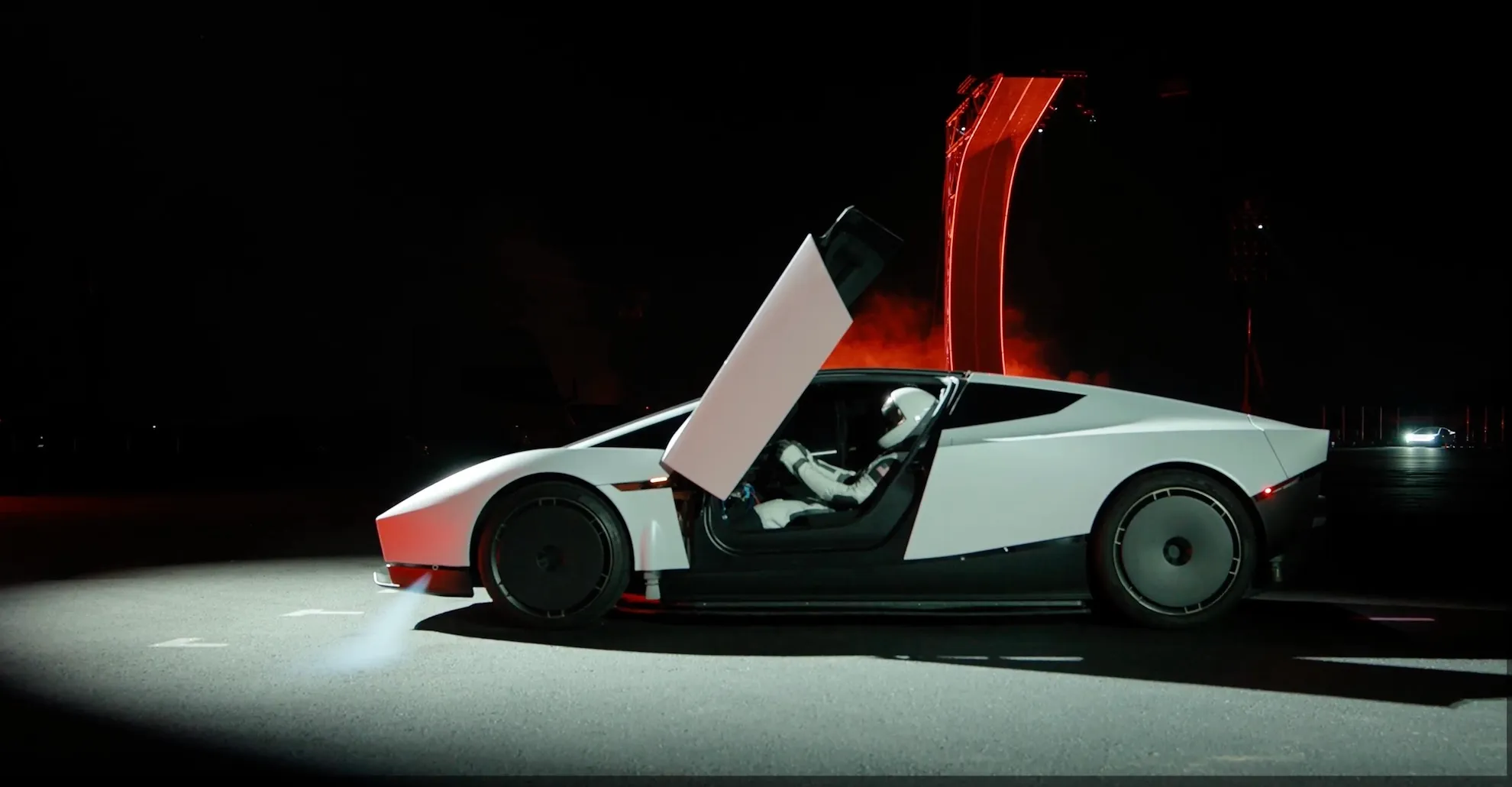
According to TechCrunch, Tesla unveiled the updated version of its second-generation Roadster sports EV near Waco, Texas, on October 15, 2026. The unveiling came nearly nine years after the first showing. The car, equipped with cold-gas thrusters developed jointly with SpaceX, accelerates from 0 to 60 mph (0–96 km/h) in under one second. Tesla CEO Elon Musk called it at the unveiling "the best of the last human-driven cars." Series production is planned for 2028, and the final retail price has not yet been announced.
Aerial Demonstration
The event took place at the SpaceX test site in McGregor, Texas. Reuters reported the exact location and start time — 8:55 p.m. local time on Thursday — before the event began.
During the demonstration, the car climbed an inverted ramp using a combination of powerful fans and thrusters, spun in the air, and landed softly back on the asphalt. It also flew over Cybercab, Cybertruck, Tesla Semi, Model Y, and Model 3 vehicles while in motion.
These maneuvers showed that the thrusters are used not only for acceleration but also for controlling the car in the air: compressed air is released from tanks through the thrusters, lifting, spinning, and returning the car to the road. The ramp demonstration showed the thrusters can overcome the car's weight and lift it into the air; flying over five different Tesla models showed the system can also control a moving car.
"the best of the last human-driven cars" — Elon Musk, Tesla CEO (TechCrunch)
Three Versions
The three versions differ in purpose and equipment: one is designed for daily driving, another for the race track, and the third for aerial maneuvers. The Performance version is for the road: a two-seater with active aerodynamics and a multi-mode suction system designed for high efficiency both on the road and on the track. The Thrust version is for racing: a two-seater with rear-mounted cold-gas thrusters delivering 0–60 mph acceleration in under one second. The Rocket version is for the air: a single-seater with 10 cold-gas thrusters placed around the car.
All three versions offer a range of about 480 km (300 miles), while the top speed exceeds 370 km/h (230 mph).
Orders are already being accepted: a $50,000 deposit is required to reserve the Performance version and $250,000 for the Thrust — a fivefold difference in deposits between the two versions. The Rocket version will not go on open sale and will only be available by invitation. The final retail price has not been announced.
Thruster System
Tesla's vice president of engineering, Lars Moravy, said at the event that the Roadster will use 10 thrusters fed by 600 liters of compressed air; the air reserve can be refilled. According to him, all usable cavities in the car are filled with carbon fiber overwrapped pressure vessels (COPV).
The heart of the system is the pressure vessels filling the car's body cavities: they supply the thrusters with compressed air. The 600 liters of compressed air is the system's energy source; when the air in the tanks runs out, it can be refilled, so the thrusters are not single-use. In 2024, Musk wrote on the social network X that the Roadster had been redesigned, that 0–60 mph acceleration would be under one second, and that it was a product of the Tesla–SpaceX collaboration.
A Nine-Year Delay
The second-generation Roadster was first unexpectedly shown in 2017 at the end of the Tesla Semi presentation. It was then introduced as a $200,000 car, with deliveries said to begin in 2020; customers paid a $50,000 deposit, and some paid $250,000 for the 1,000-unit Founders Series.
The project has since been delayed in 2020, 2021, 2023, and 2024. The unveiling attempt scheduled for October 1 was postponed due to severe weather — the new unveiling took place nearly nine years after the first showing. According to Reuters, the reservation deposit stayed at $50,000 throughout those years.
Analysts' Take
Morningstar analyst Seth Goldstein called the Roadster Tesla's new "halo" car — a high-performance luxury model showcasing the company's best engineering solutions. By his estimate, Tesla will sell about 2,000 Roadsters a year; that is only a small fraction of the 1.6 million cars sold last year.