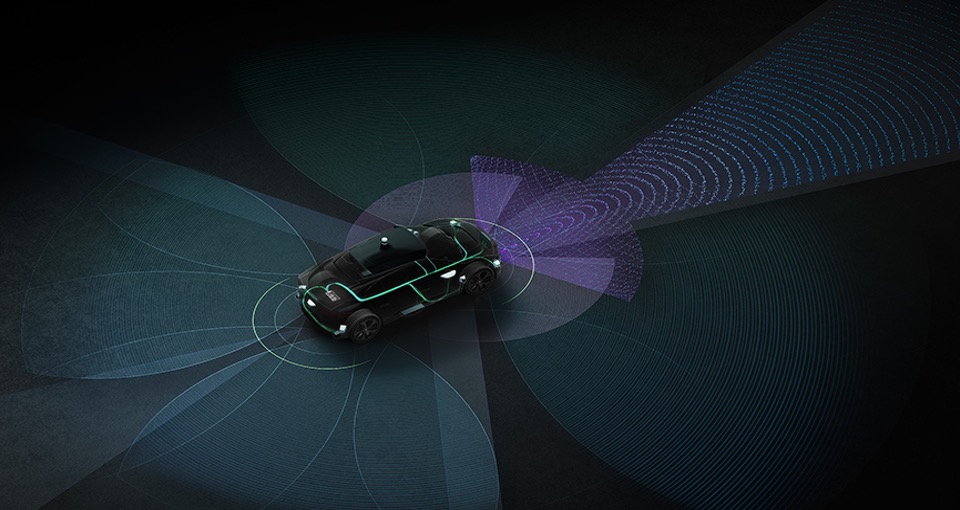
On October 15, 2026, Volvo Cars and NVIDIA announced an expanded partnership in autonomous driving technology. Reuters reported that the Swedish automaker will combine its expertise in automotive safety systems and engineering with NVIDIA's artificial intelligence and computing technologies. The goal of the partnership is to jointly develop technologies ranging from driver-assistance features to fully autonomous driving modes. The results of the collaboration will debut in the next generation of Volvo vehicles and form part of the largest product refresh in the company's history.
Technology Stack
Future Volvo models will use three NVIDIA components. The first is the Hyperion sensor and compute architecture: it unifies into a single system a suite of sensors that perceive the vehicle's surroundings and a computing platform that processes the massive stream of data they generate in real time. The architecture provides the hardware foundation the car needs to see, hear, and understand its environment.
The second is the Alpamayo driving software stack: a software layer that governs the car's driving decisions on the road. This layer analyzes sensor data and decides when to turn, change speed, or stop. According to NVIDIA, Alpamayo is distributed as open-source software and has been downloaded by more than 650,000 developers — a sign that the software has been tested by a broad engineering community.
The third is the Halos safety assessment layer: it checks and evaluates every action of the system against safety requirements. This layer separately verifies the safety of the autonomous system before it makes a decision. The three components work together as follows: Hyperion gathers data about the environment, Alpamayo makes driving decisions based on it, and Halos separately verifies the safety of each decision. This three-stage chain ensures the system's reliability. When all three components work together, the result is an autonomous driving system capable of traveling both on city streets and on highways. This is the key technical foundation for Volvo's transition from driver-assistance features to fully autonomous modes.
Timeline and Geography
The technology will appear in Volvo vehicles by 2030. It will debut in a next-generation Volvo model — according to Reuters, this will be part of the company's biggest product offensive in its history. In other words, the new autonomous system will take center stage in Volvo's next-generation model lineup.
The company plans to roll out the technology in several regions simultaneously. However, China is not on the list: the new system will launch at the same time in markets outside China. Simultaneous rollout across multiple regions means the technology will launch in parallel rather than market by market; Reuters' report specifically notes that China is excluded. The technology will therefore launch in parallel across several regions, with the company presenting it across a broad geography.
Phases: From Supervised Driving to 'Eyes-Off'
The first phase focuses on supervised driving features — in this mode, the driver remains fully responsible for the vehicle. The system assists on the road, but the steering wheel and situational control always stay with the human. This is a cautious first step in bringing autonomous technologies to market.
Volvo's stated long-term goal is to gradually expand capabilities. The next steps will introduce hands-free driving in cities and on highways — in this mode, the driver can take their hands off the wheel. After that, a transition is planned to 'eyes-off-the-road' (eyes-off) and even 'mind-off-the-road' (mind-off) driving modes. In these modes, drivers will be able to fully divert their attention from the road.
"The first deployment focuses on supervised driving features with drivers remaining responsible, while Volvo's stated ambition is to gradually introduce more advanced capabilities including hands-free driving in urban areas and on highways, toward eyes-off and mind-off driving." — From Volvo's statement (via Reuters)
Background: Since 2017
The expanded partnership builds on a long-standing collaboration that began in 2017. Over the past years, the two companies worked together on autonomous driving, and that work is now moving to a new, broader stage: Volvo will deploy NVIDIA's solutions — its sensor architecture, driving software, and safety layer — across its vehicles at scale.
At the same time, according to TechCrunch, neither the financial value of the deal nor the model in which the technology will first appear has been disclosed. The companies have not revealed the commercial terms of the partnership or named the first vehicle.