HackerRank released its artificial intelligence (AI)-based interview agent Chakra to general availability on October 5, 2026. Before the launch, the product spent six months in beta testing, during which it conducted more than 500,000 interviews — a sign that the agent went through large-scale trials. Companies including Snowflake, Snorkel, and Capgemini took part in the test, and HackerRank also tried the product with its own team. Chakra was thus tested in real interviews involving both external clients and the company's own employees before its general release. (TechCrunch)
How Chakra Conducts Interviews
In a Chakra interview, the candidate receives a practical task involving work on real project code and completes it in a dedicated workspace with a built-in AI assistant. Drawing on the context of the candidate's actions, the agent asks follow-up questions along the way — for instance, why that particular approach was chosen or how the solution would change if a new constraint were added. The evaluation therefore focuses not only on whether the final answer is correct, but also on the candidate's reasoning process and decision-making logic. As the candidate works through the task, Chakra tracks every step and brings the interview closer to real working conditions. Where traditional coding tests mostly have candidates submit a finished answer, this format also assesses how they analyzed the problem, how they used the assistive tool, and how they justified their solution.
Three Stages Become One Interview
HackerRank co-founder and CEO Vivek Ravisankar says Chakra combines three separate stages of the traditional hiring process into a single interview.
"Chakra combines a process that previously consisted of three separate stages — a recruiter screen, a take-home assignment, and a follow-up interview with an engineer — into a single interview," Ravisankar said.
Under the old arrangement, a candidate first went through an initial recruiter screen, then completed a take-home assignment, and was finally invited to a follow-up interview with an engineer. Chakra packs those three stages into one interview format: the recruiter screen, the practical task, and the engineer's questions merge into a single session. The company aims to fundamentally reshape the hiring process this way — replacing the old system, where each stage was organized separately, with one unified evaluation flow. That reduces employers' need to schedule and hold three separate meetings, and makes the process shorter and simpler for candidates.
Assessment: Three AI Agents
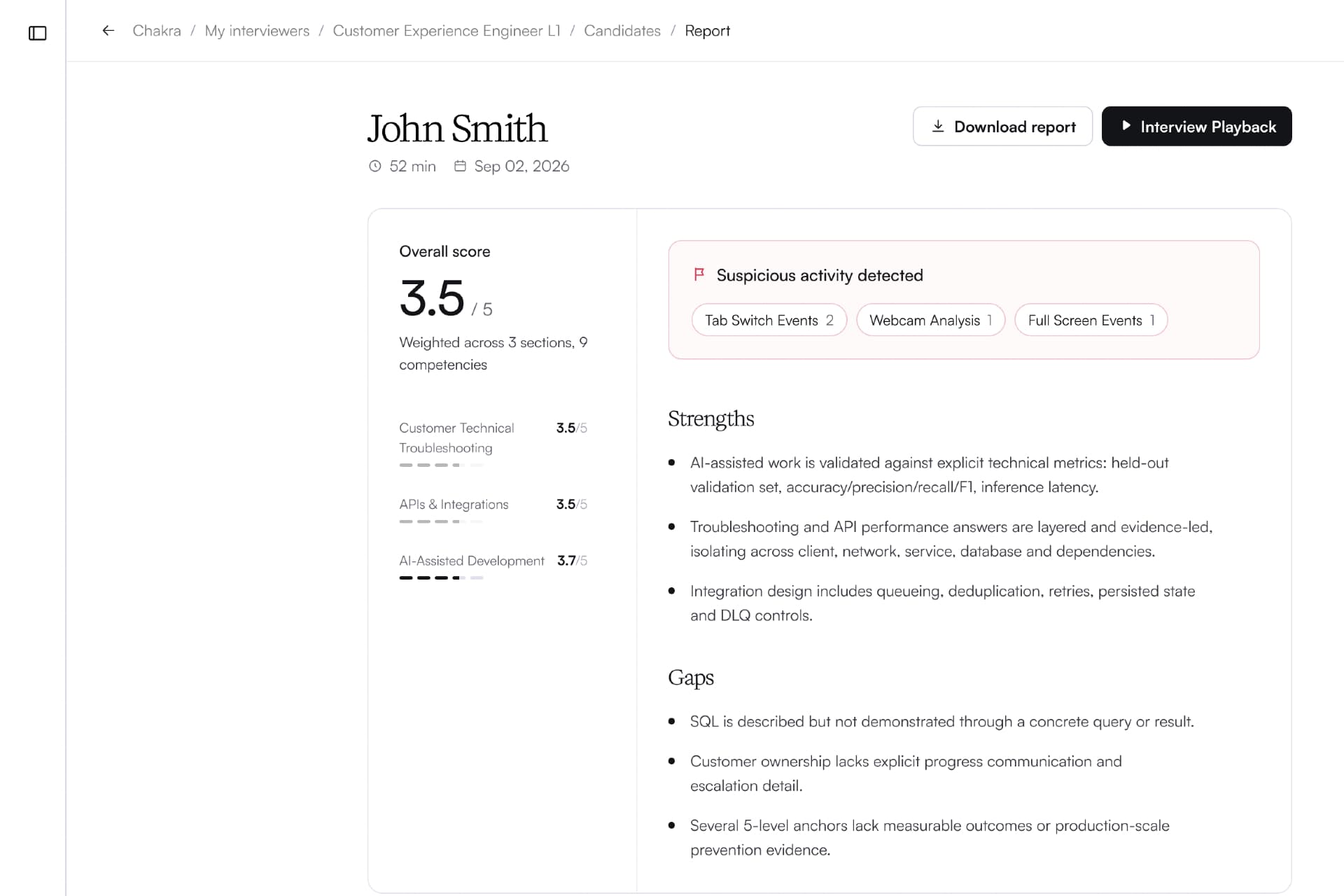
According to HackerRank's official blog (HackerRank), Chakra works as a system of three separate AI agents. The first agent — Interview Creator Agent — turns a job description into a structured interview plan: based on the vacancy text, it builds a list of expectations to be checked during the interview. The second agent — Interviewer Agent — conducts a live voice interview, speaks with the candidate directly, and adapts the direction of the conversation based on their answers. The third agent — Reporter Agent — reads the interview transcript and scores each defined expectation separately.
Each expectation is scored on a 4-point scale; the score rests on concrete evidence from the transcript and is then normalized to a 0–5 scale. The company stresses that no conclusion absent from the transcript makes it into the report — the assessment is built solely on recorded evidence. The approach is meant to keep scoring transparent: a hiring manager can see which part of the interview each score is based on. Because the three agents' duties are clearly separated, the planning, interviewing, and scoring stages do not overlap — each performs its own defined function.
Less Suspicious Activity, Final Call Stays Human
According to HackerRank, signs of suspicious activity on Chakra interviews were recorded 70–80 percent less often than with traditional assessment methods. The company attributes this to candidates being openly allowed to use AI during the interview: since the assistive tool is officially available, the need and incentive to use it secretly diminish.
At the same time, Chakra only evaluates candidates — the final hiring decision stays with humans. The company designed the agent as an assessment tool, not a decision-maker. AI-powered hiring is increasingly regulated: New York City, for example, requires employers using automated hiring tools to pass an independent bias audit and to notify candidates in advance about the use of such a tool. HackerRank said compliance with such requirements was part of the product's development.