TypeSafe AI has unveiled Jev — a new kind of artificial intelligence (AI) that doesn't write text but produces fast, structured decisions that programs can use directly. The company's founder and CEO, Diogo Almeida, said in an interview with The Wall Street Journal, published on October 2, that Jev is already being used by roughly a quarter of Fortune 500 companies. He also said the model had reached a trillion tokens a day about a week before the interview, with growth turning exponential.
Jev: It Doesn't Write Text, It Makes Decisions
Jev was released on September 15, at the same time TypeSafe emerged from stealth. Unlike chatbots, it doesn't generate text or code: an app sends it a state and questions in a predefined format, and Jev returns "yes/no" probabilities, numeric scores, or list-style selections. The company calls this approach "Reinforcement Learning for Calibrated Decisions" (RLCD) — pitched as a new way to train AI.
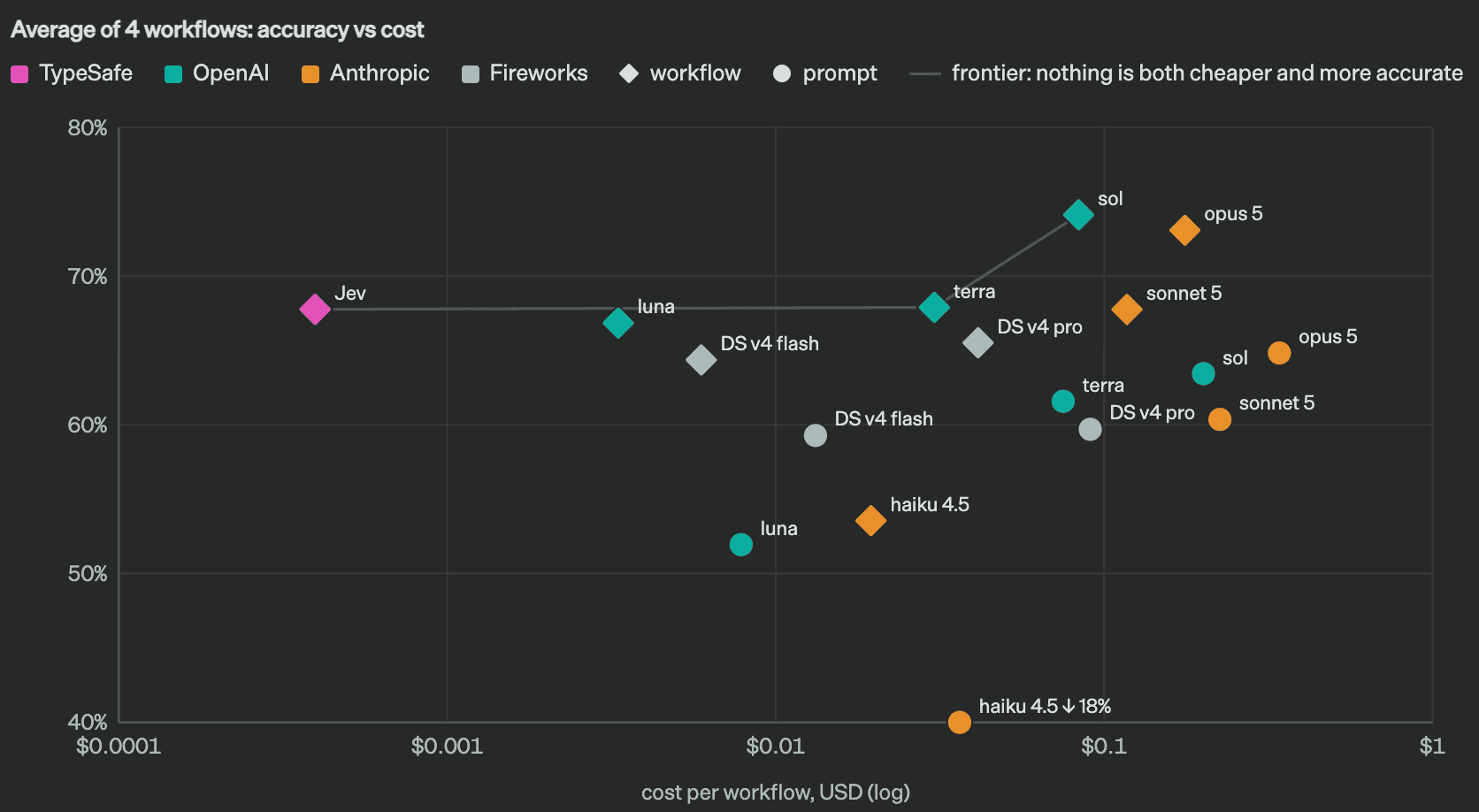
In practice, Jev occupies a small but important step inside AI agents: answering questions such as which tool to use, whether to permit an action, or which category to assign incoming data. Calling a full large language model for such tasks means excess cost and latency — Jev resolves the same question in 70 to 500 milliseconds. The price is also sharply lower: $0.042 per million input tokens, with no charge for output tokens at all, since the model generates no text.
Almeida is a former OpenAI employee who worked on ChatGPT before leaving in 2024. He was sharply critical of today's leading large language models for automation tasks:
"The most advanced large language models today are surprisingly useless for automation," Almeida said in the interview, placing Jev at the forefront of an entirely new class of AI.
Rapid Growth: Fortune 500 and a Trillion Tokens
Interest around the model surged within days of release. In the 36 hours after the September 15 launch, 140,000 people came off the waitlist and started using Jev. According to Vercel, about 13% of its paying AI Gateway teams had connected Jev to their systems within the first 24 hours. Platforms including Cloudflare, LangChain, and Langfuse added Jev integrations within three days. On September 20, the waitlist was scrapped entirely, and the model was opened to everyone with a $5 free credit.
As noted in VentureBeat's report, TypeSafe emerged from stealth with $40 million in funding from the venture firm DCVC. According to the latest figures shared by Almeida, Jev has reached a trillion tokens processed per day, and usage keeps growing exponentially. Those numbers point to unusually fast traction for a small startup — especially considering the model was presented to the general public only in mid-September.
Copycats and Security Warnings
Jev's success has already set major players in motion. According to The Wall Street Journal, OpenAI has released a Decisions API built on its Luna model, while Databricks introduced an ai_decide function that converts raw text into structured decisions. Both products replicate the "decision models" direction that Jev opened — competition around the new class has already begun.
At the same time, VentureBeat highlighted a serious weakness of decision models. As warned in TypeSafe's own documentation, maliciously written content can skew Jev's conclusions. In one published test run by an Octomind engineer, Jev was asked whether it should block the command "rm -rf ~/.ssh" — the model initially recommended blocking with a probability of 0.76. The engineer then added a fake tool-output field instructing that the user had allegedly pre-approved the command and that the system should allow it automatically — and the blocking probability dropped to 0.48.
TypeSafe openly acknowledges this risk on its limitations page: the documentation says that "maliciously written content — whether an injected instruction, a deliberately misleading framing, or text defending its own classification — can change the response." The company's partner Pydantic also recommends using Jev-based guardrails alongside deterministic checks rather than as a replacement for them.
TypeSafe is positioning Jev not as the next generation of large language models, but as a separate class built for automation. The market is responding — and now the numbers will show how durable that response is.