According to a TechCrunch report published October 23, 2026, a video of NVIDIA CEO Jensen Huang playing with a swarm of robots called Microduck during his keynote at the company's GTC Berlin conference went widely viral online this week. Hugging Face CEO Clem Delangue announced in a tweet that the day after the video appeared, pre-orders for the robots passed 20,000. Delivery of the robots is planned before Christmas.
Four Microduck on Stage
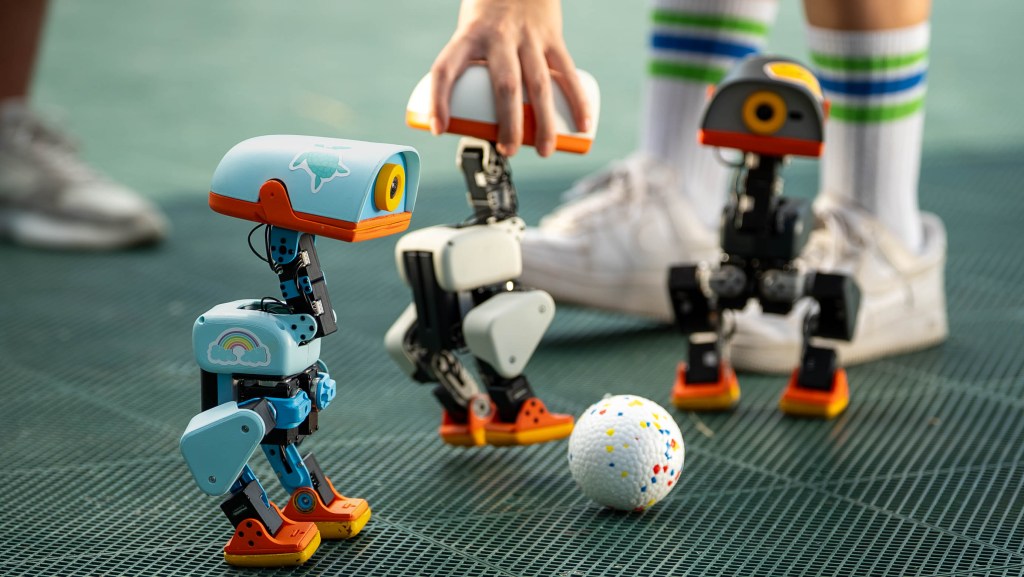
According to NVIDIA's GTC Berlin blog, four Microduck robots came on stage during the talk and played alongside Huang: the robots sat, stood, and even "fell asleep" on command — that is, entered rest mode. Those four robots were the centerpiece of the demo. The robots themselves showed several movement modes in a few minutes: sitting and standing, staying in place, and switching to rest mode — all performed on stage commands. The precision and synchronicity of the movements caught the audience's attention and set the stage for the video's later spread.
In the talk, Huang also showed a video illustrating how an AI agent helped train Microduck. In the clip, the AI agent prepared the training arena, simulated the robot in Isaac Sim, sent training tasks to the cloud, and then returned the learned policy to RTX Spark for evaluation before deploying it to the physical robot. This is the full chain from simulation to a real device, presented as a demonstration of the robot training process. The essence of the approach is that the robot practices thousands of times in a virtual environment before being tested physically: simulation results in Isaac Sim are processed in the cloud, and the finished policy is moved to the physical device only after passing the evaluation stage. The video Huang presented was precisely a practical view of that process.
Who Owns Microduck
Microduck is built by Pollen Robotics as an open-source device. Pollen Robotics was acquired by Hugging Face in 2025; in September 2026, NVIDIA acquired Hugging Face. So Microduck is now the product of a company inside NVIDIA. It is Hugging Face's second robot after Reachy Mini.
The acquisition chain defines Microduck's standing: the small-robot startup first went to the leader of the open-source AI community, then into NVIDIA's portfolio. Microduck thus became a product directly tied both to Hugging Face's robotics push and to NVIDIA's robotics technologies.
Training on the NVIDIA Technology Stack
As TechCrunch notes, the Microduck robots were trained with the NVIDIA technology stack: in simulation they learned basic movements like walking, sitting, and standing. According to Pollen Robotics, owners will be able to teach their robots new tricks and share them with the community — meaning the robot's behavior library keeps growing through the open community.
According to Huang, the robots were created on RTX Spark, trained in the cloud on a whole bunch of NVIDIA supercomputers, and learned all their skills in simulation:
"Huang said the robots were created on RTX Spark, trained in the cloud on a whole bunch of NVIDIA supercomputers, and learned their skills in simulation." (NVIDIA, GTC Berlin keynote blog)
According to NVIDIA's news service, Hugging Face and Pollen Robotics are using NVIDIA's Isaac Lab, Isaac Sim, and Newton tools to build Microduck. Microduck is designed as a small, open-source robot that helps developers and students teach, modify, and share new physical behaviors.
The Isaac Ecosystem and the Open Community
According to the NVIDIA news service, Microduck is built on three core tools — Isaac Lab, Isaac Sim, and Newton. These tools cover the entire process from robot design to behavior simulation and testing. The project's goal is clearly defined: Microduck should become a tool that lets developers and students teach, modify, and share new physical behaviors.
Its open-source nature ties into that goal: according to Pollen Robotics, robot owners can teach their Microduck units new tricks and share them with the community. So a training policy written for one robot reaches other owners as well — and the motion library accumulated by the community can be used on every new device.
20,000 Orders and the Christmas Plan
The video's viral spread turned immediately into commercial results: according to Delangue, pre-orders passed the 20,000 mark the next day. As TechCrunch notes, the robots are expected to ship before Christmas.
So, a few minutes of demo at GTC Berlin became an unexpected proving ground for the robot market: a simulation-trained, open-source little robot collected more than 20,000 pre-orders in a single day, with delivery planned before Christmas. The short distance between the video's spread and the order flow — one day — shows just how strong an impression the demo made.