On October 27, 2026, Opera announced WebAI, a proposed web standard. The standard would allow websites and browser extensions to use artificial intelligence models directly on the user's device, without turning to cloud servers. In this way, AI capabilities would be delivered inside the browser itself, through models running on the user's computer.
What Is WebAI
WebAI is a proposed standard that would let websites and extensions use local artificial intelligence through the browser. According to Opera's definition, the standard would let sites and extensions generate text, classify content, and understand the connections between pieces of data using models that run on the device. These capabilities run inside the browser: the user does not need to subscribe to a separate AI service or run AI infrastructure.
The essence of the standard is moving the model onto the device. Processing is done not in the cloud but on the user's computer, so data does not leave the device. WebAI is being proposed not as a separate product but as a web standard: developers of sites and extensions will be able to use it in their own products. For a developer, this means that adding an AI feature does not require building separate infrastructure — the model runs through the browser, on the user's device.
Three core capabilities define the practical content of the standard. Text generation means producing new text inside the browser. Content classification makes it possible to group and organize information. Understanding connections between data serves to determine how separate pieces of data relate to one another. All three are performed with a local model, without turning to an external service.
When and Where It Will Be Available
WebAI is not yet open to everyone. It has been introduced in the Opera One browser as an opt-in early preview: nothing is downloaded until the user turns it on. WebAI is said to arrive in the Opera GX and Opera Neon browsers at a later stage. Supported devices are 64-bit Windows computers and Mac computers with Apple silicon chips.
Early preview status shows that the standard has not yet been widely rolled out. In the first stage, the capability is open to Opera One users, while other Opera browsers will be added at the next stage. The device requirement is linked to this: local models require a modern processor and sufficient hardware capability, so support is currently limited to 64-bit Windows systems and Mac computers with Apple silicon chips.
Which Models Will Work
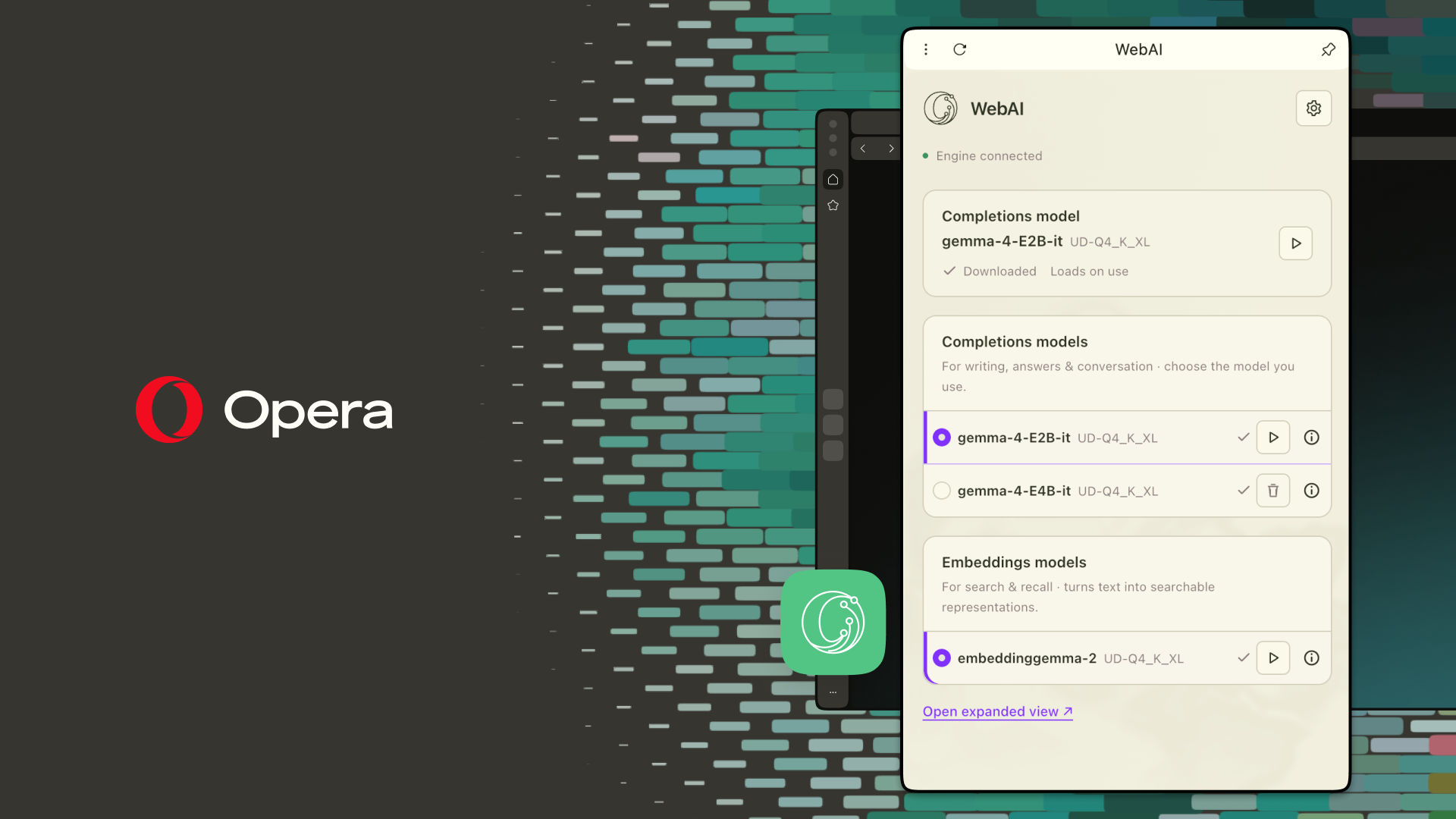
WebAI is not tied to a single model: Opera describes it as model-agnostic and built around open models. The company emphasizes that the standard is backed by companies such as Google and Microsoft. The model-agnostic approach does not lock the user or the developer into a single closed system: the choice of model is made among open models.
At launch, WebAI supports Google's Gemma model, while on Mac computers Apple's on-device foundation model is also available. In this way, from launch, open and on-device models from two major technology companies can be used through the browser. Model choice also depends on device type: the Apple model is specific to Mac computers, while Gemma is more broadly available.
Privacy and Control
WebAI works on an opt-in basis: nothing is downloaded until the user turns it on. Per-site permissions determine which websites may use local artificial intelligence. The user makes a separate decision for each site: a site without permission cannot access the local model. This approach leaves control with the user.
Data stays on the device because processing is done not in the cloud but on the user's computer. At the same time, performance depends on the user's hardware: since the model runs on the device, results may vary depending on the computer's technical capabilities. A more powerful device will give a faster result, while processing will be slower on a weaker device.
The capabilities of WebAI can be summarized briefly as follows:
With WebAI, anyone can generate text, classify content, and understand connections between data — all directly in the browser, without an AI subscription and without running AI infrastructure.
More details are available in the Opera press release and the TechCrunch article.
Companion Launch: HTML-in-Canvas
Alongside WebAI, Opera also released HTML-in-Canvas technology. It lets developers embed real, interactive web pages inside 2D and 3D scenes. A web page inside a scene remains interactive: the user can work directly with elements on the page.
The technology is aimed at games and Opera GX. In a game environment, live web pages can be shown as a scene element, while the page retains its interactivity. That WebAI and HTML-in-Canvas were released on the same day shows Opera developing local artificial intelligence and interactive 3D environments in the browser in parallel. WebAI is now in early preview, available on an opt-in basis in Opera One, and Opera GX and Opera Neon will be added at a later stage.