NVIDIA and the University of Washington's Institute for Protein Design (IPD) have introduced a new open artificial intelligence model called RFD4-Proteina. The model was announced on October 21, 2026, at the GTC event in Berlin and combines programmable protein design capabilities with protein search. RFD4-Proteina is released as an open model on the NVIDIA BioNeMo platform, aimed at accelerating scientific discovery.
What the model can do
RFD4-Proteina enables scientists and scientific AI agents to create targeted protein designs. In practice it works like this: the researcher provides the required molecular input data, project constraints, and evaluation criteria — and the model searches for and refines matching protein variants against those requirements. The word "programmable" means exactly this: the design is not found by chance but is built in a controlled way, tailored to the stated goal.
According to NVIDIA, the model's expected application areas include designing proteins capable of halting disease processes and creating proteins that detect disease markers in diagnostic tests.
Proteins are molecular "machines" that perform nearly all of the essential tasks of cell life — designing new variants of them could open the way to new drugs, more precise diagnostics, and industrial applications. The challenge is that finding a protein with the desired function requires searching an enormous design space: the number of theoretical variants reaches astronomical values, and testing them manually or at random is practically impossible. RFD4-Proteina is aimed at accelerating exactly this search with computational power. The model helps researchers review and prioritize candidates for laboratory testing, but the final verdict always rests on experimental results — a design's real effectiveness is determined only in the laboratory (NVIDIA Newsroom).
Test results across four benchmarks
In the tests described in the study, RFD4-Proteina showed a higher computational design success rate and higher generation throughput than baseline methods across four benchmark suites — protein binding, small-molecule binding, enzyme scaffold design, and DNA binding.
These four areas cover the core tasks of protein engineering. Proteins binding to each other plays a central role in identifying drug targets and understanding biological processes — many drugs are aimed precisely at protein-protein interactions. Binding small molecules is a key stage in screening drug candidates: the more strongly a candidate molecule binds to the target protein, the more effective the drug can be. Enzyme scaffold design serves the creation of new catalysts — such enzymes are widely used, from drug manufacturing to industrial chemistry. The DNA-binding task is tied to designing proteins that regulate genes, that is, molecular "switches" that control gene expression.
High results across all four areas point to the model's broad applicability rather than narrow specialization. At the same time, computational success must be confirmed under laboratory conditions — the real behavior of a synthesized protein is determined only through experiments.
The BioNeMo ecosystem and scientific agents
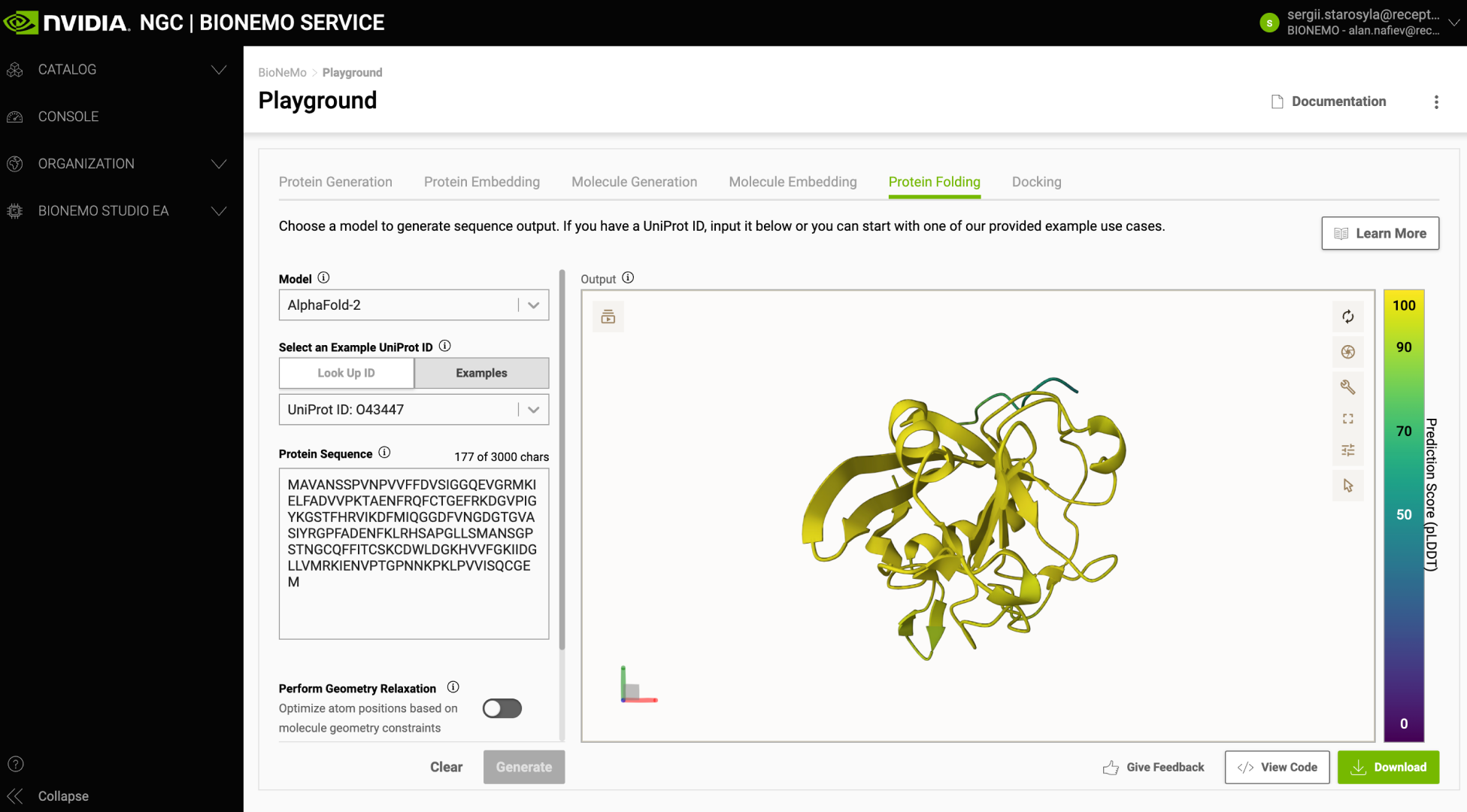
RFD4-Proteina was introduced as part of the NVIDIA BioNeMo open development platform. BioNeMo is an open platform for AI-based biology and drug discovery that connects drug design, scientific data, and laboratory workflows through scientific agents and specialized models. Scientific agents unite design, experimentation, and learning into a continuous loop — this serves to shorten the path from hypothesis to experiment.
David Baker's comment
"RFD4-Proteina opens doors to new solutions in medicine, sustainability, materials, and biotechnology," said David Baker, 2024 Nobel laureate in chemistry and director of the University of Washington's Institute for Protein Design (IPD). "Making the model open allows researchers around the world to build on its capabilities." (Source: NVIDIA Newsroom)
Baker leads the University of Washington's Institute for Protein Design and was awarded the Nobel Prize in Chemistry in 2024. According to him, releasing the model openly gives researchers worldwide a way to advance their work on the basis of its capabilities.
Open license and availability
RFD4-Proteina was released as an open-source model under the BSD 3-Clause license. The model card was published by NVIDIA on Hugging Face, and researchers can access the model weights starting today.
BSD 3-Clause is one of the permissive open licenses. In practice this means: the model can be used free of charge in both scientific research and commercial projects, modified, and redistributed as part of one's own products. The conditions are short: the copyright notice and license text must be preserved, and the license holder's name may not be used to promote a product without their consent. This license choice matters for the scientific community — it opens the way not only to studying the model but to including it in real research and development workflows.
Open weights and the model card's placement on Hugging Face make it easy for researchers to immediately download the model and test it in their own computing environment.