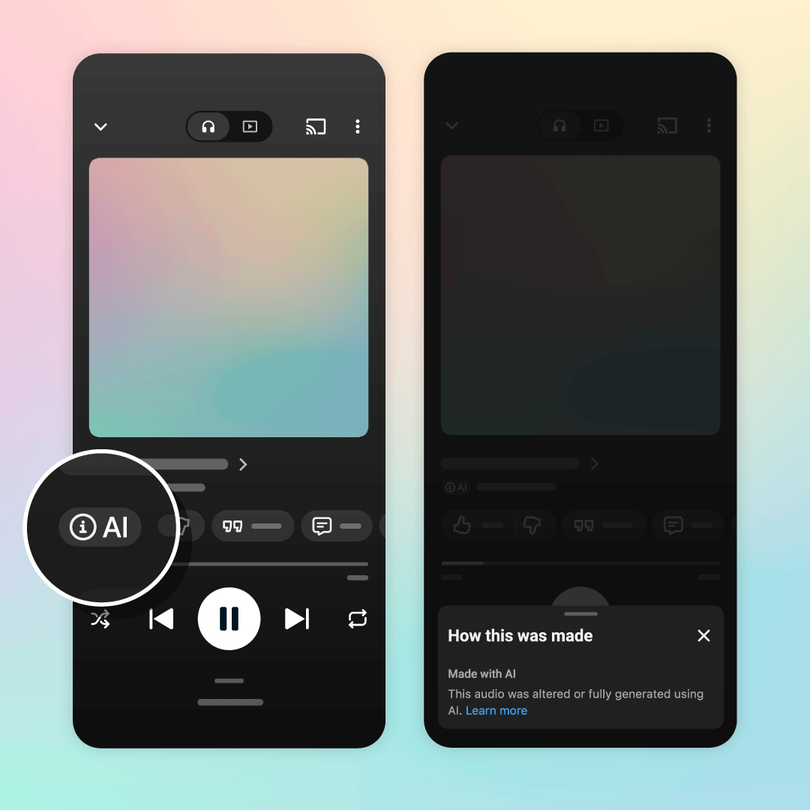
On October 14, 2026, YouTube introduced new labels in YouTube Music that flag songs created primarily with the help of generative artificial intelligence (AI). The labels tell the listener that a track was created with generative AI involvement — for example, they are applied when a song's melody and vocals were generated by a generative model. The new labeling system is rolling out from today; the company said the labels will later be extended to the main YouTube app as well.
Labels appear on the player page
When listening to a track in which AI played a significant role, the label appears directly on the player page. Tapping the label opens a simple menu with additional information about AI's exact role in the track's creation — from this menu, the listener can learn which part of the track involved AI. The menu reveals AI's specific role — for instance, that the melody or vocals were created with the help of a generative model.
These labels will not be limited to YouTube Music: according to the company's announcement, they will later appear in the main YouTube app too. In this way, music content created with AI involvement will be labeled consistently across both of the platform's services.
The labeling system's goal is to give listeners and viewers accurate and correct information about the music they are listening to. YouTube is working on this together with its music partners and relies on the labeling principles already in use across YouTube. According to the official YouTube blog, detailed transparency rules and standards are published in the YouTube Help Center.
How tracks are identified
YouTube identifies AI-created tracks in two ways: its own detection tools and transparency disclosures from music partners. Partners declare their use of generative AI through delivery templates in DDEX or CSV format, choosing one of three labels: "Fully Gen AI", "Partly Gen AI", or "No Gen AI".
The "Fully Gen AI" label means the track was created entirely by AI — from start to finish. "Partly Gen AI" covers mixed works: in this case, AI-created parts are combined with the artist's own live performance. The "No Gen AI" category includes tracks where generative AI was not used at all — for example, tracks edited only with sound-correction tools like Auto-Tune stay in this category, since such editing does not count as generative AI.
This three-tier system is tied to the process of partners delivering tracks to the platform: when delivering a track, the partner declares through a special field in the DDEX or CSV template the extent to which generative AI was used. YouTube compares these declarations with the results of its own detection tools and assigns the track the matching label. In this way, labeling relies both on automated detection and on partners' official disclosures.
Why now
This step comes at a time when AI-created music is spreading rapidly across streaming services. According to TechCrunch, Deezer said in July that it was receiving nearly 90,000 fully AI-created tracks per day — a figure that shows just how large the scale of AI music has become.
Spotify has already found its own solution to this problem: the service uses AI labels and has introduced a filter against music spam. Apple Music plans to release "Made With AI" labels by the end of this year as part of its AI transparency tags initiative. So major streaming platforms are rolling out transparency tools for AI-created music one after another.
Spotify's approach includes a spam filter alongside labeling — meaning the service not only shows AI involvement but also fights low-quality mass content. And Apple Music's "Made With AI" tags will be introduced as part of the company's AI transparency initiative.
Transparency, not restriction
YouTube's approach emphasizes transparency rather than expanding prohibitions. The company chose not to hide or ban AI's involvement in a track's creation, but to openly inform the listener about it. Importantly, AI involvement on its own does not strip a track of its right to monetization on the platform. The new labels serve exactly this purpose — helping listeners understand the role of AI in music creation. This approach directly affects creators who use AI tools as well: AI involvement on its own does not deprive a track of its monetization rights, but that involvement is openly labeled. And the listener gains a fuller picture of the track through the label.
"YouTube is focusing on transparency instead of expanding bans: the fact that AI participated in creating a track does not automatically deprive it of the ability to be monetized on the platform." — TechCrunch