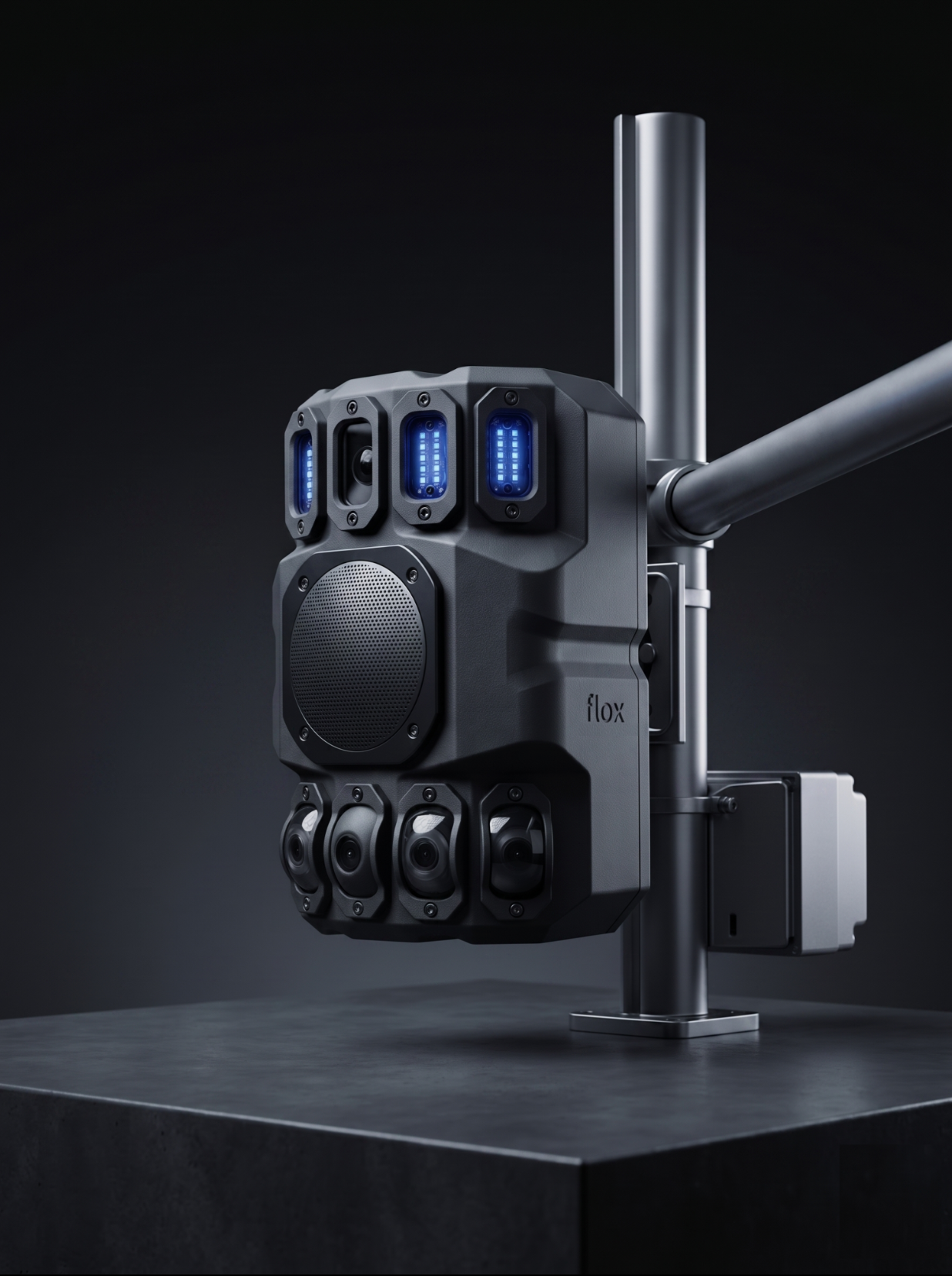
The Stockholm startup Flox Intelligence, which builds AI devices that keep wildlife away from railway tracks, airports, and roads, has reached the final of the Startup Battlefield 200 competition, held on October 13, 2026 in San Francisco as part of TechCrunch Disrupt 2026. Co-founder Sara Nozkova told TechCrunch in an interview that the devices are already operating at around 150 sites across North America, Europe, and Australia — airfields, road and rail corridors, national parks, and other facilities. At the same time, the company announced it is opening a $10M Series A funding round.
How the Device Works
Flox spun out in 2020 from the AI lab of KTH Royal Institute of Technology in Stockholm. Its main product is a battery-powered edge device mounted on poles or trees: all computation happens on the device itself, with nothing sent to the cloud.
It works like this: when a motion sensor detects movement nearby, the device wakes up and the camera switches on. An on-device model identifies the animal species and its behavior in the frame, then emits a deterrent sound matched to that species. According to the company, the system learns from every encounter and deliberately varies its responses — so animals don't get used to a single signal and start ignoring it.
The company sells devices for a one-time payment, then charges an annual fee from the first year for software and the AI subscription. Flox also offers clients a software platform that shows where devices are located and what is happening on the ground; the platform produces reports that meet regulatory requirements and is also used for biodiversity monitoring. The long-term goal is to move the software onto machines operating outdoors — trains, cars, and drones.
Nozkova has spent 13 years in transport and autonomous vehicles; she says systems built to move on roads and other controlled environments fail quickly as soon as nature interferes. Devices are deployed at airfields and airport perimeters, along road and rail corridors — especially fence ends and crossings along wildlife corridors — in national parks, farmland, urban areas, mines, and critical infrastructure such as electrical substations.
Trials With Alstom
Train manufacturer Alstom is Flox's OEM partner: the company pays an annual fee to install Flox software on vehicles such as trains.
In an Alstom press release dated May 11, 2026, the two companies say they are running large-scale field trials of AI technology that detects and deters wildlife along Swedish railways. Early trials showed the system can recognize animals such as moose, roe deer, foxes, and wild boar with high accuracy. The trials are being conducted on several Swedish rail lines together with regional rail operator Tag i Bergslagen and the operator VR, with support from the Swedish innovation agency Vinnova.
Funding and Expansion Plans
So far the company has raised around $5M across pre-seed and seed stages; the seed round was led by Unconventional Ventures and Tilia Impact Ventures, with GENIUS NY, Norrsken, Satgana, and angel investors also participating. The company is now opening a $10M Series A round — the funds will mainly go toward growing the device count from 150 to several thousand and expanding the system beyond wildlife. Nozkova says the company aims to close 2026 with revenue of around $1.5M.
There is competition too: Robin Radar's Scarecrow system uses species-specific alarm sounds to disperse birds and logs activity, while iCHASE identifies birds with computer vision and directs a moving laser at them. According to Nozkova, Flox's advantage is the breadth of the system and the field data collected: that data shows what makes a moose or a grizzly bear move away safely.
"Physical AI is stepping out of the factory and into the messy, living outdoors," Nozkova said. "Every machine operating outside will have to understand nature."
The Scale of the Problem
Wildlife collisions are a global problem. According to the US Federal Aviation Administration (FAA), such collisions cost the country's civil aviation an average of $272M a year in 1990–2025. In France, rail operator SNCF reports that stray animals affect over 8,000 trains a year and rank among the top five causes of delays; in Brittany alone, trains struck 120 animals in 2023, disrupting 660 journeys and causing over 15,000 minutes of delays.
Flox's immediate plan is to use the $10M Series A to grow the device count to several thousand and expand the technology beyond wildlife, including farmland and critical infrastructure. The company aims to close 2026 with $1.5M in revenue.