Google on October 14, 2026 announced a new set of measures protecting Android devices from mobile fraud. The package covers three main areas: an opt-in Enhanced protection mode in the Google Messages app, chat scam alerts expanding to more devices, and new safeguards around call forwarding and screen sharing.
Enhanced protection: cloud Gemini and on-device Gemini Nano
The new mode is designed as an opt-in security setting that enables the strongest and smartest protective tools in Google Messages. According to The Verge, Enhanced protection will reach users in the coming weeks.
Enhanced protection shifts the Scam Detection mechanism into an enhanced mode powered by Private AI Compute: the most capable cloud Gemini models evaluate the complex message context in conversations with unknown senders and help recognize a scammer's intent faster. As Google emphasizes, the analysis runs inside the Private AI Compute environment — data is processed in encrypted form and is not accessible even to Google itself.
When this mode is enabled, on-device Gemini Nano combines real-time web signals to assess whether an unfamiliar link is trustworthy before the user taps it. This makes it possible to catch newly registered scam sites that haven't made it into catalogs yet. Warnings about links from unknown numbers have also been reworked: they give users more time and clearer context to stop and think before tapping. Previously, such warnings only worked on devices in certain countries or on devices with Android Advanced Protection enabled.
Notifications: from Pixel to the whole ecosystem
Notification-level scam alerts, already working on Pixel phones, report suspicious messages in popular chat apps right in the notification panel — without opening the app. In partnership with Android device makers, Google plans to bring this on-device protection to hundreds of millions of additional users by the end of this year.
Protection against call forwarding and screen sharing
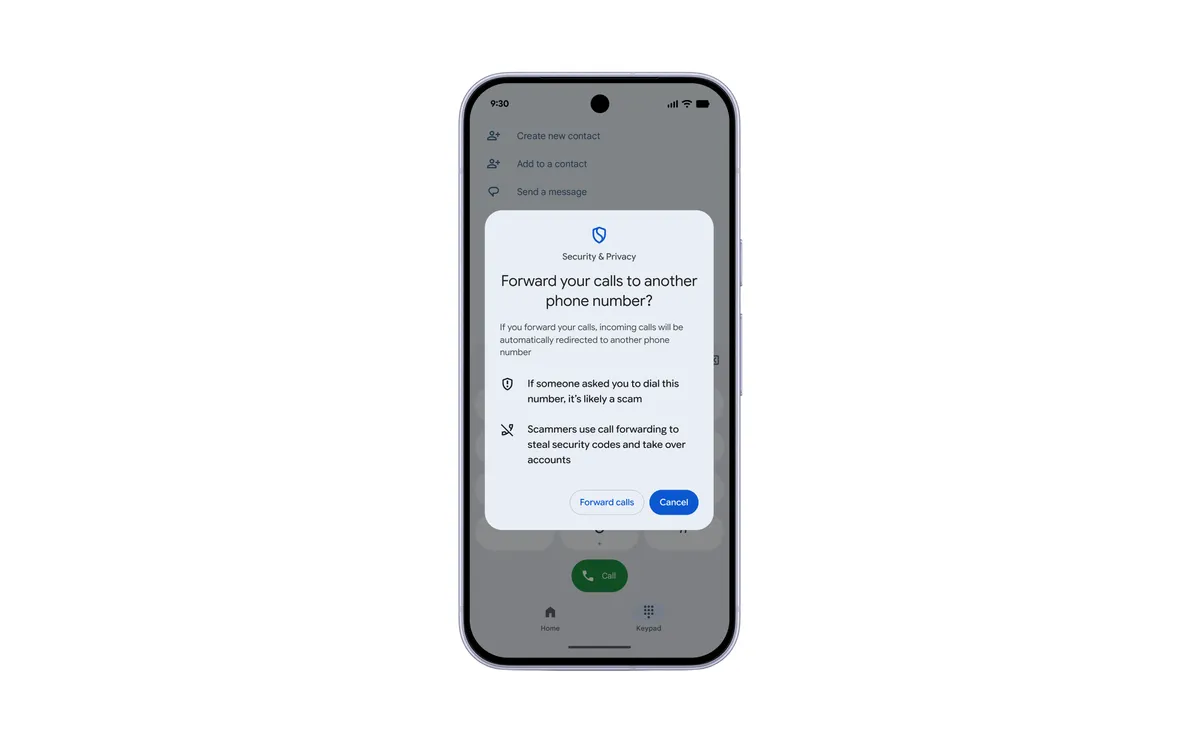
Scammers often secretly forward incoming calls to another number to steal one-time codes and take over accounts. Android now prevents apps from quietly enabling call forwarding in the background. If a scammer talks a user into manually entering an MMI forwarding code on the phone dialer, Android will warn them before the code takes effect.
Scammers often run this trick posing as "bank staff" or "tech support": they call the victim and ask them to dial a special code on the phone supposedly to "protect" their account. Once the code is entered, incoming calls and SMS messages — including one-time verification codes from the bank — get forwarded to the scammer's number. The new protection breaks exactly this chain: apps can't enable forwarding in the background, and a warning appears before a manually entered code takes effect.
Measures hiding sensitive data during screen sharing have also been expanded: the protection that automatically blanks login and payment fields now also applies to Chrome and Android WebView. This protection targets the same scenario: when a scammer talks a victim into sharing their screen, passwords or card numbers don't appear on screen — the fields are automatically blanked.
The numbers: 5 million suspicious messages a month and the Brazil experience
AI-powered Scam Detection in Phone by Google and Google Messages now flags more than 5 million suspected scam calls and texts every month.
— Google Blog
According to Google, the AI-powered scam detection system in Phone by Google and Google Messages flags more than 5 million suspected scam calls and messages every month.
The fight against bank impersonation fraud has also intensified. The verified financial calls feature, built together with Banco do Brasil, Itaú Unibanco, and Revolut, has blocked more than 3 million spoofed bank calls since launching in June. According to the Brazilian Federation of Banks (FEBRABAN), bank impersonation fraud in the country surged 195.7% over 12 months — showing how necessary such protective measures are.
By Google's count, the AI system in Phone by Google and Google Messages alone detects more than 5 million suspected scam calls and messages each month. The new package deepens protection along three lines: opt-in Enhanced protection for those who want the strongest defense, alerts reaching hundreds of millions of additional devices, and barriers against the scammers' two most common tricks — call forwarding and screen sharing.
Official announcement on the Google Blog; another story on this topic in the site archive: DeepMind and GovTech's on-device scam detection model.