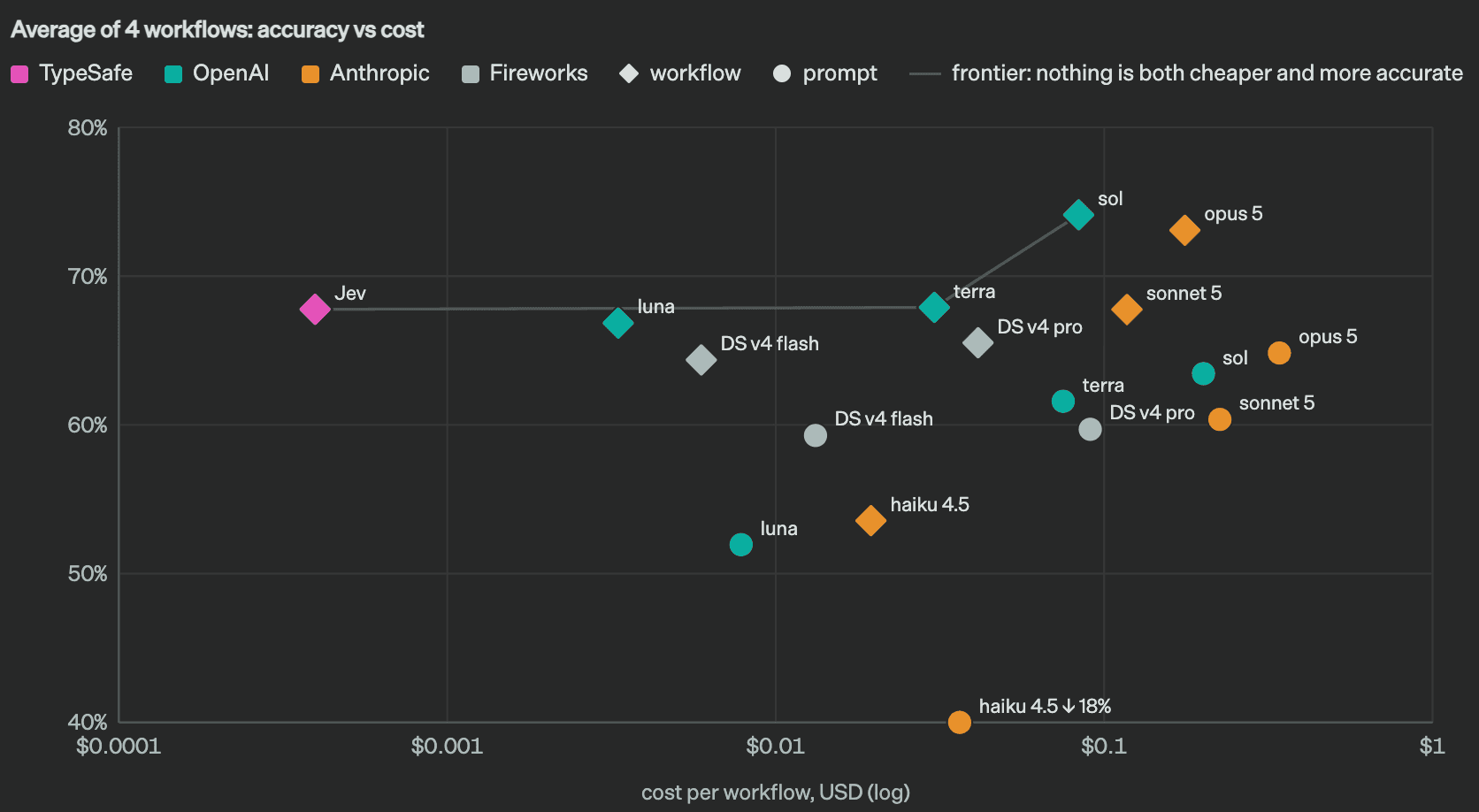
Per a report published by Vercel on October 16, the Jev decision model from startup TypeSafe AI was adopted by 35% of the platform's paid teams just two weeks after release. According to TechCrunch, that figure is nearly double the runner-up, Sonnet 5.5, making Jev the fastest-adopted model in AI Gateway history. It is the first hard-numbers confirmation of the surge of interest that built up around the model over the past month.
The Numbers: 13% in the First 24 Hours, 35% in Two Weeks
According to Vercel's official blog, 24 hours after launching on AI Gateway, Jev was already in use by nearly 13% of paid teams — twice the share of the GPT-5.6 family and more than six times that of the Fable 5.1 model. Within two weeks, coverage reached 35%, a result no model in the company's history had achieved.
According to the Vercel blog's assessment, 24 hours after launching on Gateway, Jev was used by nearly 13% of paid teams — twice the GPT-5.6 family and more than six times the share of Fable 5.1; it thus became the fastest-adopted model in Gateway history. — Vercel official blog
TechCrunch notes that AI Gateway data offers a limited view: large labs such as OpenAI and Anthropic, which serve customers through their own application programming interface (API), are not included in these statistics. In other words, the numbers primarily reflect the choices of developer teams building apps on the Vercel platform. Even so, the data shows the hype around Jev has turned into real usage — the model is spreading faster than all pre-release forecasts predicted.
How Jev Works
Jev launched in a limited release on September 15. It is a probabilistic decision model: an app sends it context and a set of questions, and Jev evaluates the questions in parallel, returning typed choices, scores, or true/false answers with probabilities.
The model's key difference is that instead of generating free-form text, it is designed to select one of several predefined answers. Large language models (LLMs) write text by predicting each word in sequence, while Jev picks one of a limited set of response options — for example, in classification tasks like determining whether an incoming prompt is malicious or benign. Because outputs are constrained, the model runs cheaper and faster than alternatives like Sonnet, making it well suited for rapid classification of large data volumes.
That very approach set Jev apart in the era of traditional models: the idea of a model that doesn't write text but only makes decisions was initially seen as a niche interest, yet Vercel's numbers show practical demand is far broader. As we reported earlier, TypeSafe AI raised $870 million in funding a few weeks after release, reaching a $7.5 billion valuation.
Vercel Tests It in Its Own Product as Competition Heats Up
Vercel is not just an observer but also among Jev's earliest users: the company uses Jev instead of GPT-6 Luna for the task of classifying malicious prompts. In other words, the very company behind the adoption record runs Jev in production — which makes the report's numbers even more credible.
Jev's approach has already pushed giants like OpenAI and Amazon to release their own competing offerings. According to TechCrunch, the model drew heavy attention in the weeks after release, and a new market direction is now taking shape — so-called "decision models": large labs are refining large language models while also shipping their own solutions in the lightweight, constrained-output model segment.
Open-Source Models' Share Keeps Growing
Another finding of the report concerns the momentum of open-source models: they now account for more than 70% of tokens flowing through AI Gateway and nearly 25% of total spend. In other words, more than three out of every four tokens on Gateway are processed by an open model — a ratio that shows how firmly the open ecosystem has entrenched itself among developers.
At the same time, the market itself is growing fast: spending on the labs developing frontier models has grown tenfold, even as their share of total spend has shrunk. According to TechCrunch, these two trends together reinforce the view that frontier models and open alternatives may be complements rather than competitors — as the market expands, both segments keep growing.
Timeline: From Release to Record in Just Over a Month
Jev's journey to date spans just over a month. The model launched in a limited release on September 15. In early October, TypeSafe announced that roughly a quarter of Fortune 500 companies were using Jev. On October 9, the company announced it had raised $870 million in funding at a $7.5 billion valuation. And Vercel's October 16 report added a new, independent confirmation to this sequence: the model's adoption is record-breaking not only in corporate announcements but also in real usage data on the developer platform.